

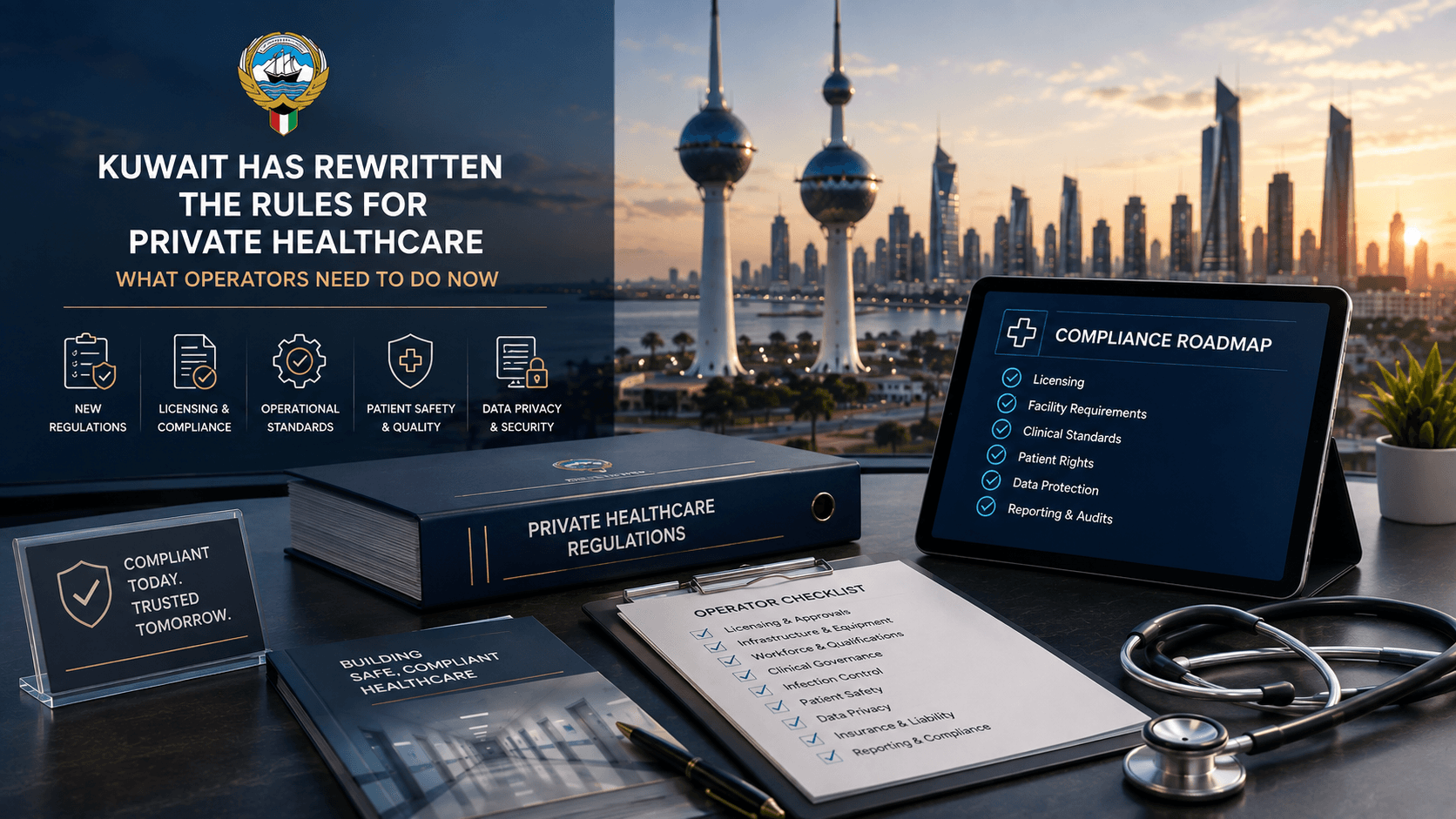
Kuwait Has Rewritten the Rules for Private Healthcare: What Operators Need to Do Now
17-08-2026
Ministry of HealthHealthcare ComplianceMedical LicensingPrivate Clinics
The Ministry of Health published six ministerial decisions in the Official Gazette, Kuwait Al-Youm Issue 1804, dated 16 August 2026, covering surgery, weight loss procedures, psychological services, cosmetic treatments, pharmacy licensing and biological medicines. Taken together they amount to a reset of the compliance framework for anyone operating a healthcare business in Kuwait, and all of them are already in force.
Why this matters
Most regulatory changes give businesses a running start. This package does not. The psychology decision requires unlicensed providers to stop offering services immediately, the surgery rules demand documentation practices an inspector can check on the next visit, and department councils have three months to file their operation classification lists. Healthcare in Kuwait is delivered by companies as much as by doctors: hospital groups, clinic chains, medical complexes and pharmacy operators all carry obligations under these decisions, and breaches fall under Law No. 70 of 2020 on the practice of medicine.
Surgery and medical interventions (Decisions 220 and 221)
Decision No. 220 of 2026 applies to both the government and private sectors. Operations may only take place in facilities licensed by the Ministry for that purpose. Informed consent, meaning the patient's documented agreement after being told what the procedure involves, must be recorded in the medical file before any operation. Surgeons may only perform procedures within the privileges approved for their specialty by the department councils, and every operation must be entered in the medical file and the operating theatre logbook with the names of the lead surgeon, assisting surgeons and nursing staff. Tissue samples must be sent for testing and the results followed up and communicated to the patient. Each department council must submit a classification list of the operations in its specialty to the Ministry within three months of publication.
Decision No. 221 of 2026 deals with bariatric surgery and non-surgical weight loss procedures in both sectors. These procedures are barred for patients under 18. Where a psychiatric report is required, it must come from a licensed psychiatrist at registrar level or above and is valid for three months. The Ministry will keep a national registry of bariatric operations, and complications arising in the private sector carry reporting duties back to the Ministry.
Psychological services: the hard stop (Decision 225)
Decision No. 225 of 2026 is the item that needs attention first. It creates a complete licensing regime for psychological treatment and counselling services: minimum degrees from institutions recognised by the Ministry of Higher Education, supervised practical experience, and specific certification requirements for behaviour analysts. Services may only be provided by a licensed practitioner inside a facility licensed by the Ministry, whether delivered in person or remotely. The decision expressly prevents providers from repackaging psychological services as training, consulting or personal development to escape the rules, and it bars these practitioners from electroconvulsive therapy and brain stimulation techniques.
The transitional rule is strict. A company holding a valid commercial licence that had already started its Ministry licensing process before the decision may complete it. A company that had not must stop providing psychological services immediately, and continuing is treated as a breach of Law No. 70 of 2020. Wellness centres, coaching businesses and clinics offering counselling on a commercial licence alone should treat this as a same-week issue. The decision replaces Ministerial Decision No. 79 of 2025.
Cosmetic clinics (Decision 232)
Decision No. 232 of 2026 amends the conditions for cosmetic procedures. Procedures are allocated to specialties through approved lists, the specialist physician must examine the patient before every session, and a psychiatric report is required in defined cases, valid for three months. Where complications occur, professional responsibility sits with the physician who performed the procedure, and a medical incident report must go to the complications committee. Clinics should check that their treatment menus match the specialty allocations and that their consent and referral paperwork reflects the new requirements.
Pharmacies and medicines (Decisions 235 and 214)
Decision No. 235 of 2026 resets the paperwork for private pharmacy licensing and the handling of medicines. A new pharmacy licence requires, among other items, the commercial licence, a civil information certificate for the premises, signature attestation from the Public Authority for Manpower and a premises inspection by the Ministry's drug control inspectors. The decision also regulates changes to pharmacy floor area, external signage and advertising, and staff duty records. Decision No. 214 of 2026 reorganises the prescribing and dispensing of biological medicines in Ministry facilities through approved lists, specialist committees and switching protocols, a change pharmaceutical suppliers will feel in formulary and tender decisions.
Practical steps this week
First, map every service line in the business against the six decisions and confirm the facility licence actually covers it. Second, if the business offers psychological or behavioural services on a commercial licence alone, pause the service and establish where it stands under the transitional rule, because the decision leaves no grace period. Third, update consent forms and medical file templates so consent, surgeon names, follow-up plans and incident reports are recorded the way the decisions require. Fourth, diarise the three-month deadline for classification lists and review under-18 and psychiatric report policies in bariatric and cosmetic practice. Fifth, pharmacy operators should reconcile their licence file against the new checklist before any renewal, relocation or fit-out change.
WEFAQ advises healthcare operators, and the investors and lenders behind them, to treat this package as a single compliance event rather than six separate circulars: one audit, one gap list, one remediation plan, done now rather than at licence renewal.
• • •
Source: Ministry of Health Ministerial Decisions Nos. 214, 220, 221, 225, 232 and 235 of 2026; Kuwait Al-Youm Issue 1804, dated 16 August 2026.
This article is provided for general information only and does not constitute legal advice. For advice specific to your circumstances, please contact WEFAQ Law Firm.
Related articles


Kuwait Media Law 2026: What It Means for Influencers, Companies and Media Businesses
Learn more
UPDATE: What Kuwait's Amended Public Tenders Law Means for Contractors and Suppliers
Learn more
The Capital Markets Court Is Being Retired: What Decree-Law 91/2026 Means for Issuers, Brokers and Investors
Learn more
UPDATE: How Kuwait's Government Sukuk Programme Will Work
Learn more