
Our News

Discover the latest News

Recent mandates, firm announcements, and news that matter to our clients and to the Kuwaiti legal market.

Kuwait Customs Imposes Definitive Anti-Dumping Duties on Float Glass from China and Iran
Anti-Dumping DutiesKuwait CustomsGCC Trade RemediesFloat Glass

Kuwait Customs Imposes Definitive Anti-Dumping Duties on Float Glass from China and Iran

The General Administration of Customs has issued Customs Instructions No. 27 of 2026, published in Kuwait Al-Youm Issue 1806 dated 30 August 2026, imposing definitive anti-dumping duties on imports of float glass originating in or exported from China and Iran. The duties apply from 5 September 2026 and will remain in force for five years. The instructions give effect in Kuwait to a GCC-wide decision adopted by the Financial and Economic Cooperation Committee at its 125th meeting and the Industrial Cooperation Committee at its 55th meeting on 29 October 2025, on the recommendation of the Permanent Committee for Combating Harmful Practices in International Trade. Anti-dumping duties are extra charges placed on imports sold below their home-market price in a way that harms local industry. The measures cover unworked float glass and glass ground or polished on one or both faces, in sheets, including glass with an absorbent or reflective layer, under tariff items 7005.10.00, 7005.21.00 and 7005.29.00 of the GCC unified customs tariff. Ultra-clear float glass is excluded. The duty is a percentage of the CIF value of the shipment. For China, Yaohua (Qinhuangdao) Glass Co., Ltd pays 6.7 per cent; CNG (Weihai) Special Glass Co., Ltd and three cooperating producers not selected in the sample (Zhangzhou Kibing, Langfang Jinbiao and Tengzhou Jinjing) pay 8.3 per cent; all other Chinese producers and exporters pay 14.4 per cent. All Iranian companies pay 56.3 per cent. The amounts are collected and treated in the same way as customs duties. WEFAQ's view: importers, glazing contractors and developers should identify the actual producer behind each shipment and review supply documents before 5 September, since the applicable rate depends on the named company and the product's exact specification. Read more: for the full analysis, read our companion blog article: ' Kuwait Enforces GCC Anti-Dumping Duties on Float Glass: What Importers and Contractors Should Do Before 5 September '.

Learn more
Health Ministry Publishes Eight Decisions: Controlled-Medicine Manufacturing, Drug Promotion Rules and a Binding Private-Sector Price List
Ministry of HealthPharmaceuticalsDrug PricingCompliance

Health Ministry Publishes Eight Decisions: Controlled-Medicine Manufacturing, Drug Promotion Rules and a Binding Private-Sector Price List

The Ministry of Health has published eight ministerial decisions in Kuwait Al-Youm Issue 1806, dated 30 August 2026 (pages 5 to 56), most of them signed on 24 August. Together they build the executive layer under Decree-Law No. 159 of 2025 on combating narcotics and psychotropic substances and update long-standing rules under the pharmacy profession law, Law No. 28 of 1996. Three decisions implement the 2025 narcotics law directly. Decision No. 289 of 2026 sets the conditions for cultivating the narcotic plants listed in Schedule 5 of Group One of the law for medical or scientific research purposes: a two-year renewable licence, fenced and guarded sites, approved registers and notification of the Interior Ministry's drug control administration. Decision No. 290 of 2026 regulates psychotropic preparations kept aboard Kuwaiti and foreign aircraft and vessels for first aid, limited to single-use injections used on board, with losses reported within 48 hours. Decision No. 291 of 2026 creates the licensing regime for producing and manufacturing medicines that contain narcotic or psychotropic substances, under the oversight of the Ministry's pharmaceutical inspection. Decision No. 296 of 2026 sets rules for promoting medicines and medical products and for company representatives inside Ministry facilities. Violations are graded from simple to serious: promotion outside the approved leaflet, misleading information and conflicts of interest sit in the serious band, and offering benefits or influencing procurement can be referred to the competent authorities, with penalties under Law No. 28 of 1996. Decision No. 297 of 2026 fixes the price list of human medicines in the private sector under Article 13 of Law No. 28 of 1996, applying the pricing mechanism adopted by Decision No. 62 of 2026. The itemised schedule runs to dozens of pages. Rounding out the package, Decision No. 294 of 2026 standardises first-aid kits and sets minimum first-aider and kit numbers for events by expected attendance, Decision No. 302 of 2026 tightens the circulation of prescription veterinary medicines, including monthly stock returns to the Ministry, and Decision No. 301 of 2026 makes limited amendments to the unified dress code rules for health facilities. WEFAQ's view: Pharmaceutical importers, agents and manufacturers now face three compliance fronts at once: pricing against the new list, marketing conduct under Decision No. 296, and controlled-substance licensing and registers under Decisions No. 289 to 291. A gap analysis of pricing files, representative conduct policies and controlled-substance records before inspectors call is the sensible first step. Source: Kuwait Al-Youm Issue 1806, pages 5 to 56, dated 30 August 2026. This article is provided for general information only and does not constitute legal advice. For advice specific to your circumstances, please contact WEFAQ Law Firm.

Learn more

UPDATE: Ministry of Islamic Affairs Named Competent Authority for the Places of Worship Law
Places of Worship LawCouncil of MinistersRegulatory Implementation

UPDATE: Ministry of Islamic Affairs Named Competent Authority for the Places of Worship Law

The Council of Ministers has designated the Ministry of Islamic Affairs as the competent ministry, and the Minister of Awqaf and Islamic Affairs as the competent minister, for the application of Decree-Law No. 72 of 2026 regulating the establishment and management of places of worship . Decision No. 975 of 2026 was issued on 16 August 2026, published in Kuwait Al-Youm Issue 1805 dated 23 August 2026 (page A4), and applies from its issuance. This is the first implementation step for the law, which WEFAQ reported when it was gazetted in July 2026. Decree-Law No. 72 of 2026 created a licensing framework for building and running mosques and other worship premises, covering approvals, management and supervision. Until now the law did not say which government body would operate that framework. Decision No. 975 settles the question, so licence applications and supervision will run through the Ministry of Islamic Affairs. The next step to watch is the executive regulations, which are expected to set out application procedures, required documents and the timelines for existing premises to regularize their position. WEFAQ advises developers, charities and property owners whose projects include worship premises to direct licensing enquiries to the Ministry from now on, and to prepare for executive regulations that are expected to detail procedures and documentation. Source: Council of Ministers Decision No. 975 of 2026; Kuwait Al-Youm Issue 1805, page A4, dated 23 August 2026. This article is provided for general information only and does not constitute legal advice. For advice specific to your circumstances, please contact WEFAQ Law Firm.

Learn more

KPC Approves Final Accounts of Oil Sector Services Company as Liquidation Concludes
Oil & GasLiquidationKPCCorporate Restructuring

KPC Approves Final Accounts of Oil Sector Services Company as Liquidation Concludes

Kuwait Petroleum Corporation's board of directors, sitting as the ordinary general assembly of Oil Sector Services Company, approved the company's closing liquidation accounts and declared the liquidation complete at a meeting held on 10 August 2026 chaired by the Minister of Oil. The minutes were published in Kuwait Al-Youm Issue 1805, dated 23 August 2026 (pages 28 to 29 and 176 to 179). The accounts show the liquidation was completed on 30 June 2026. Remaining funds of KWD 53,593,962 were transferred to Kuwait Petroleum Corporation on that date, and a provision of KWD 3.6 million was retained for pending court cases, including around KWD 237,000 covering twenty final judgments. The assembly discharged the liquidation committee and approved recording the end of the liquidation and striking the company from the commercial register. Oil Sector Services Company was established in 2005 and provided support services to the oil sector, including housing, social and health services and site security. The Supreme Petroleum Council, acting as the company's extraordinary general assembly, resolved to liquidate it on 18 June 2025, and the Minister of Oil appointed the liquidation committee in January 2026 by Decision No. 4 of 2026. The wind-up forms part of a wider restructuring of KPC subsidiaries, the same programme that produced the merger of KIPIC into KNPC earlier this year. WEFAQ's view: once the deregistration is recorded, the company ceases to exist as a legal person. Counterparties and claimants should confirm that their claims are captured within the litigation provision set aside in the final accounts, because pursuing recovery after a company is dissolved is considerably harder. Source: Minutes of the 21st ordinary general assembly of Oil Sector Services Company (under liquidation); Kuwait Al-Youm Issue 1805, pages 28-29 and 176-179, dated 23 August 2026. This article is provided for general information only and does not constitute legal advice. For advice specific to your circumstances, please contact WEFAQ Law Firm.

Learn more

Iron Mountain Enters Kuwait With a 100% Foreign-Owned Company Licensed by KDIPA
KDIPAForeign InvestmentMarket EntryCompany Formation

Iron Mountain Enters Kuwait With a 100% Foreign-Owned Company Licensed by KDIPA

The incorporation deed of IRM Electronic Document Storage Company, a single-person company wholly owned by Iron Mountain Consulting and Information Management LLC of the United Arab Emirates, part of the global Iron Mountain records and information management group, was published in Kuwait Al-Youm Issue 1805, dated 23 August 2026 (pages 168 to 170). The company was licensed by the Kuwait Direct Investment Promotion Authority (KDIPA) under Decision No. 4 of 2026, dated 22 June 2026. The new company has a capital of KWD 100,000, divided into 100 cash shares of KWD 1,000 each, and will carry on two licensed activities: document imaging using microfilm and electronic document storage. It was incorporated under Law No. 116 of 2013 on the Promotion of Direct Investment and the Companies Law No. 1 of 2016, and the deed was notarized on 15 July 2026. The publication matters because the default position under Kuwaiti law caps foreign ownership of most companies at 49 per cent. Law No. 116 of 2013 is the main exception: it allows KDIPA to license investment entities owned entirely by foreign investors, alongside incentives such as tax and customs exemptions. This deed shows the route working from start to finish, from the licensing decision through notarization to publication in the official gazette. WEFAQ's view: the KDIPA licence remains the most direct route to full foreign ownership in Kuwait, and this incorporation confirms the process working end to end. Investors planning a Kuwaiti entry should map the licensing decision, notarization and gazette publication stages from the outset, and choose the corporate form that fits the licensed activity. Source: Incorporation deed of IRM Electronic Document Storage Company (SPC); Kuwait Al-Youm Issue 1805, pages 168-170, dated 23 August 2026. This article is provided for general information only and does not constitute legal advice. For advice specific to your circumstances, please contact WEFAQ Law Firm.

Learn more

Decree-Law No. 79 of 2026 Amends the Kuwaiti Nationality Law
Nationality LawCitizenship RevocationElectronic CertificatesMinistry of Interior

Decree-Law No. 79 of 2026 Amends the Kuwaiti Nationality Law

Decree-Law No. 79 of 2026, published in the Supplement to Kuwait Al-Youm Issue 1805 dated 24 August 2026, amends the Kuwaiti Nationality Law issued by Amiri Decree No. 15 of 1959 in three areas. The amendments took effect on publication. First, the decree-law replaces item 4 of Article 14. Nationality may now be withdrawn from a person who deliberately added to his nationality file, or to another person's file, someone who is not his child or descendant, where this is established by an inquiry of the Supreme Committee for the Verification of Kuwaiti Nationality or by a final court judgment. Withdrawal may also extend to a child or descendant who was proven to have known of the false entry. Second, a new Article 19 provides that the certificate of Kuwaiti nationality will be issued in electronic form. The Minister of Interior will issue a decision setting the technical controls for issuing, storing, using, verifying and cancelling the electronic certificate, which carries the same legal force as the paper certificate and replaces it wherever laws and regulations require one. Third, a new paragraph added to Article 7 provides that a person who acquired Kuwaiti nationality by naturalisation has no right to vote, stand as a candidate, or be appointed in any parliamentary body. The explanatory memorandum links the amendments to Decree-Law No. 52 of 2026 and to the state's programme of correcting nationality files and completing its digital transformation. WEFAQ advises that individuals and families whose nationality files are under review should understand the new evidence and procedure rules before taking any step, and government bodies and private institutions should prepare their processes to accept the electronic certificate in place of the paper document. Source: Decree-Law No. 79 of 2026; Kuwait Al-Youm Supplement to Issue 1805, 24 August 2026. This article is provided for general information only and does not constitute legal advice. For advice specific to your circumstances, please contact WEFAQ Law Firm.

Learn more

Kuwait Issues a New Judicial Organization Law under Decree-Law No. 80 of 2026
Judicial Organization LawCourt of CassationJudicial ReformLitigation

Kuwait Issues a New Judicial Organization Law under Decree-Law No. 80 of 2026

The Council of Ministers has issued Decree-Law No. 80 of 2026 promulgating a new Judicial Organization Law, published in Supplement 2 to Kuwait Al-Youm Issue 1805 dated 26 August 2026. The law took effect on publication and repeals Decree-Law No. 23 of 1990, which had governed the organization of the Kuwaiti courts for more than three decades. It follows the Cabinet approval of the judicial reform package reported earlier this month. The law keeps the familiar four levels of courts: the Court of Cassation, the Court of Appeal, the Court of First Instance and the district courts, with a district court to be opened in every governorate by decision of the Minister of Justice. Cassation appeals are decided by five-judge panels, and an eleven-member panel chaired by the court's president will now settle any conflict between precedents so that legal principles remain consistent. The law also creates a new Cassation Prosecution, a specialised body that gives an independent legal opinion on cassation appeals. Several changes will be felt in daily practice. Courts may hold hearings and take witness evidence remotely by electronic means under rules to be issued by the Minister of Justice. Cases in which the government or a public body is a party will be heard by dedicated chambers of the Court of First Instance. Judges must hold Kuwaiti nationality by origin, and the judiciary and the Public Prosecution are to be fully staffed by Kuwaitis within five years, with serving non-Kuwaiti judges continuing until their secondments end within that ceiling. Senior judicial posts, including the Public Prosecutor, are now held for four-year terms renewable once. WEFAQ's view: the new law is the broadest reorganization of the Kuwaiti courts since 1990. Its practical effect on pending and future disputes will depend on the implementing decisions expected from the Supreme Judicial Council and the Ministry of Justice, which deserve close attention over the coming months. Read more: for the full analysis, read our companion blog article: ' Kuwait's New Judicial Organization Law: What Businesses and Litigants Should Expect '.

Learn more
Kuwait Opens Commercial Licensing for Electric Vehicle Charging Businesses
EV ChargingCommercial LicensingRenewable EnergyMOCI

Kuwait Opens Commercial Licensing for Electric Vehicle Charging Businesses

The Ministry of Commerce and Industry has opened the door to licensed electric vehicle charging businesses in Kuwait. Ministerial Decision No. 167 of 2026, issued on 17 August 2026 and published in Kuwait Al-Youm Issue 1805 on 23 August 2026, adds two new activities to the unified commercial activity guide and amends two others. The first new activity is “operating and managing electric vehicle charging stations” (unified code 351006). It falls under electricity and energy supply activities and will be supervised jointly by the Ministry of Electricity, Water and Renewable Energy and the General Traffic Department at the Ministry of Interior. The second is “sale, installation and maintenance of electric vehicle charging devices and equipment” (code 331409), supervised by the electricity ministry alone. The additions follow a request the electricity ministry submitted in July 2026 and a supporting letter from the Interior Ministry in August. The same decision renames two aviation activities at the request of the Directorate General of Civil Aviation: aircraft catering becomes “ground services for preparing and supplying aircraft meals” (code 562120), now supervised together with the Public Authority for Food and Nutrition, and “aviation schools” become “aviation training centres” (code 854991). Kuwait already has technical rules for chargers, including approved specifications and permitted locations, with an implementation phase running to the end of 2030. What was missing was a commercial licence naming the activity itself. That gap is now closed. WEFAQ's view: companies planning charging networks should add code 351006 to their licence before committing to sites, and should expect two supervising bodies, one for the electrical side and one for traffic and site layout. Suppliers, electrical contractors and car dealers already selling chargers should regularise their position under code 331409. Read more: for the full analysis, read our companion blog article: “ Kuwait's EV Charging Market Gets Its Licence: A Roadmap for Operators and Suppliers ”.

Learn more
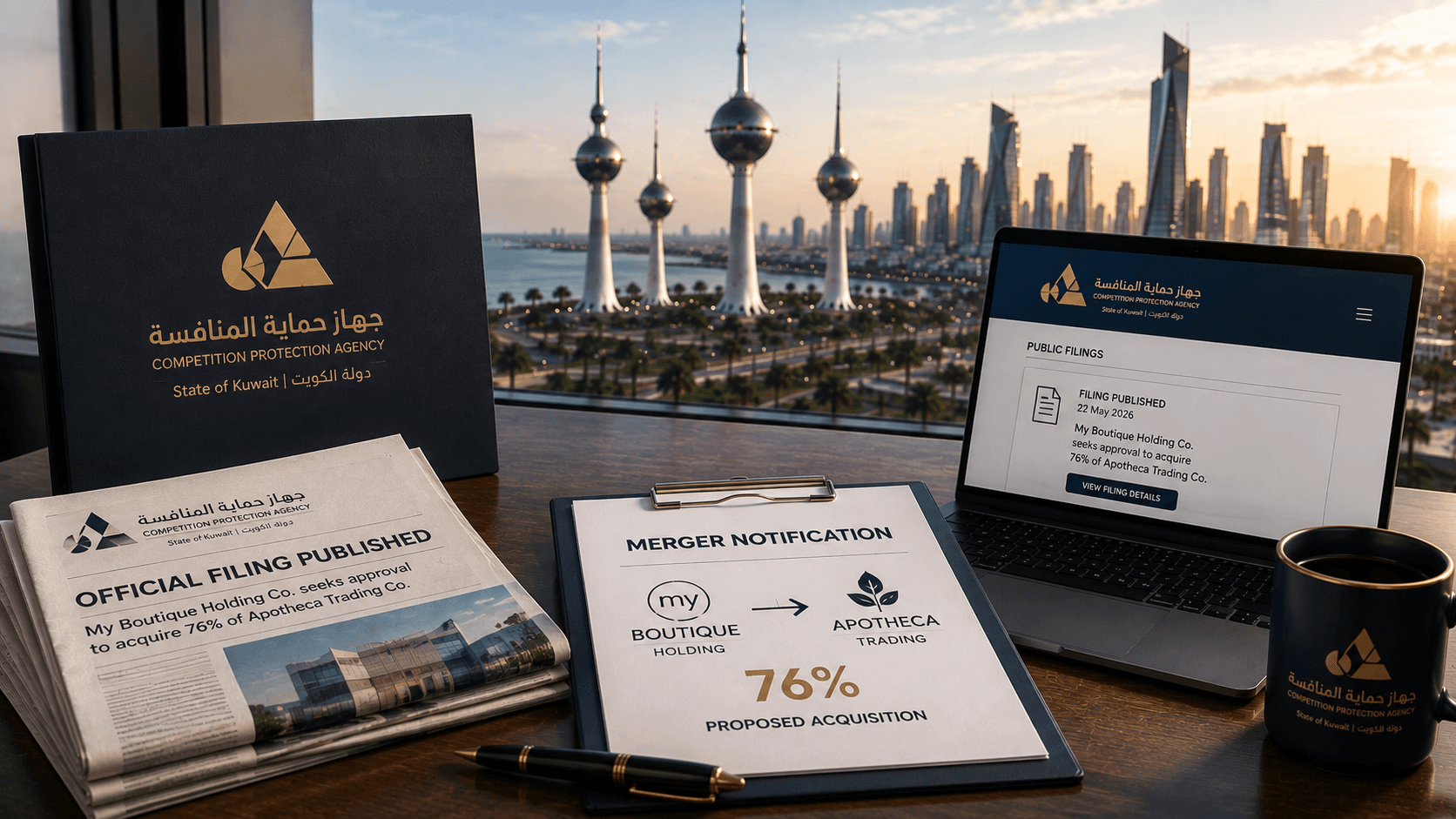
Competition Agency Publishes Filing: My Boutique Holding Seeks Approval to Acquire 76% of Apotheca Trading
Kuwait merger controlCompetition Protection Agencyeconomic concentrationRetail M&A

Competition Agency Publishes Filing: My Boutique Holding Seeks Approval to Acquire 76% of Apotheca Trading

The Competition Protection Agency (CPA) has published a notice that My Boutique Holding Company, a single person company, has applied for approval of an economic concentration: the acquisition of 76% of the shares of Apotheca Trading Company W.L.L. The notice appears in the Official Gazette Kuwait Al-Youm, Issue 1805, page 173, dated 23 August 2026. According to the notice, the acquirer's activity is managing its subsidiaries, participating in the management of companies in which it holds shares, and providing them with support. The target's activity is import, export and commission agency. An economic concentration is the competition law term for a deal that gives one party control over another, and deals above the legal thresholds need CPA approval before closing. The filing was made under Law No. 72 of 2020 on the protection of competition and Article 83 of its Executive Regulations (Decision No. 14 of 2021, as amended). Under that article, any interested party may submit a reasoned objection to the concentration within fifteen days of the notice, which runs to 7 September 2026. Objections are filed on the form available on the CPA website, with the prescribed fee, and are received at the Agency's offices on the 14th floor of Al-Hamra Tower. WEFAQ's view: the CPA continues to apply merger control well beyond industrial and financial deals; this filing sits squarely in the consumer and retail space. Parties to Kuwaiti acquisitions should treat CPA clearance, including the fifteen-day publication window, as a standing item in every deal timetable, and competitors or suppliers affected by a deal should remember the objection route exists and is short.

Learn more
Decree 130 of 2026: Capital Markets Authority Moves to the Economic Affairs Minister's Portfolio
CMACapital MarketsRegulatory Supervision

Decree 130 of 2026: Capital Markets Authority Moves to the Economic Affairs Minister's Portfolio

Supervision of the Capital Markets Authority (CMA) has been transferred to the Minister of State for Economic Affairs and Investment under Decree No. 130 of 2026, published in the Official Gazette Kuwait Al-Youm, Issue 1805, on 23 August 2026. The decree was signed on 16 August 2026 and applies from the date of its issuance. Under Article 1, the Minister of State for Economic Affairs and Investment now exercises all the powers that Law No. 7 of 2010, the law that established the CMA and regulates securities activity, reserves for the "competent minister". Since 2010 that role had sat with the Minister of Commerce and Industry, making the commerce portfolio the CMA's channel to the Cabinet. That channel has now moved. The transfer completes a consolidation that began earlier this year. Decrees issued in March 2026 placed the Kuwait Investment Authority, the Public Institution for Social Security, the Kuwait Direct Investment Promotion Authority, the General Secretariat of the Supreme Council for Planning and Development and the Central Statistical Bureau under the same portfolio, held since February 2026 by Abdulaziz Al-Marzouq. The CMA itself remains an independent regulator; the decree changes which minister answers for it at Cabinet level, not the rules it applies. WEFAQ's view: licensed persons and listed companies do not need to change anything today. Licences, filings and contact points at the CMA are unchanged. The real shift is at policy level, where capital markets now sit alongside the State's investment and planning bodies rather than with commerce.

Learn more
Kuwait Cabinet Approves Draft Law Creating Specialised Economic Courts
Economic CourtsCouncil of MinistersCommercial LitigationJudicial Reform

Kuwait Cabinet Approves Draft Law Creating Specialised Economic Courts

The Council of Ministers approved a draft decree-law issuing the Law Establishing Economic Circuits at its meeting on Tuesday 18 August 2026. Minister of Justice Counsellor Nasser Al-Sumait described the law to the state news agency KUNA the following day as a qualitative shift in Kuwait's economic justice system, built on specialised courts across all three levels of litigation. The draft, prepared by the Fatwa and Legislation Department of the Council of Ministers, creates dedicated economic circuits at the Court of First Instance, the Court of Appeal and the Court of Cassation. These circuits will hear the economic, commercial and investment disputes listed in the law, supported by a specialised technical office of judges and experts. The full text reviewed by WEFAQ runs to 32 articles. Before any dispute reaches a judge, it must first pass through a new settlement office; if the parties settle, the settlement minutes carry the force of an executory instrument, meaning they can be enforced directly like a judgment. The draft also sets up a case preparation office to complete filings before the first hearing, an electronic platform for all litigation and enforcement steps, and a specialised enforcement department linked electronically to banks and government bodies, with asset sales conducted by electronic auction. Under the draft, the law would take effect on 1 October 2027, with the Minister of Justice issuing the executive regulations before that date. Cases already pending before the Capital Markets Court and the existing court circuits would remain there until decided; only new cases would go to the economic circuits. WEFAQ's view: the draft still needs to be issued as a decree-law and published in the Official Gazette, but Cabinet approval means the architecture is now settled. Businesses with contracts or disputes in Kuwait should start factoring the new forum, and its mandatory settlement stage, into their planning. Read more: for the full analysis, read our companion blog article: ' Kuwait's New Economic Courts: What the Draft Law Means for Your Business '.

Learn more
CMA Grants Goldman Sachs Kuwait's First Institutional Marketing Permission for Foreign Funds
CMAInstitutional MarketingForeign FundsAsset Management

CMA Grants Goldman Sachs Kuwait's First Institutional Marketing Permission for Foreign Funds

The Capital Markets Authority has granted Goldman Sachs International permission to carry out institutional marketing of units of collective investment schemes established outside Kuwait, in an announcement published in Kuwait Al-Youm Issue 1804, page 230, dated 16 August 2026. The permission covers two funds: West Street Mezzanine Partners IX Offshore LP and West Street Strategic Solutions II Offshore LP. It was granted under Annex No. 4 (Institutional Marketing of Units of a Collective Investment Scheme Established Outside Kuwait) of Appendix No. 1 of Module Thirteen (Collective Investment Schemes) of the Executive Bylaws of Law No. 7 of 2010. It runs for one calendar year from the Authority's approval and expires on 6 August 2027. According to CMA statements reported in the Kuwaiti press, this is the first authorisation of its kind. Institutional marketing allows a firm to offer foreign fund units to clients who are professional by nature, a category that covers government entities, licensed and regulated financial institutions, investment funds and companies with paid-up capital of at least KWD 1 million. It operates alongside the private placement route, which WEFAQ has covered in earlier articles, as a second regulated door for foreign funds into Kuwait. WEFAQ's view: the first institutional marketing permission gives international asset managers a tested precedent. Managers weighing access to Kuwaiti institutional capital now have two clear routes, each with its own conditions, and the choice between them should be made early in fund structuring. Source: Kuwait Al-Youm Issue 1804, page 230, dated 16 August 2026; CMA statements reported by Times Kuwait and Zawya, August 2026. This article is provided for general information only and does not constitute legal advice. For advice specific to your circumstances, please contact WEFAQ Law Firm.

Learn more

CMA Clears New KIB Dollar Money Market Fund and Two KFH Capital Foreign Fund Placements
CMAInvestment FundsPrivate PlacementMoney Markets

CMA Clears New KIB Dollar Money Market Fund and Two KFH Capital Foreign Fund Placements

The Capital Markets Authority has published five supervision-sector resolutions in the Official Gazette, Kuwait Al-Youm Issue 1804, dated 16 August 2026, all of them concentrated in investment fund activity. Resolution No. 113 of 2026 grants Al-Dawli Invest Investment Company, the investment arm of Kuwait International Bank (KIB), approval to establish the KIB USD Money Market Fund. The fund will be offered to the public with variable capital of between USD 7 million and USD 1 billion, a nominal value of one US dollar per unit and a minimum first subscription of USD 5,000. It runs for ten renewable years, and the manager must keep at least KWD 100,000 invested in its units. A three-month provisional licence gives the manager time to complete the Authority's requirements and reach minimum capital before any activity begins. Resolutions No. 114 and 115 of 2026 licence KFH Capital Investment Company to market two foreign funds to professional clients in Kuwait by private placement: 150,000 units of KFH Capital Private Credit Fund 1 Designated Activity Company, established in Ireland, at USD 1,000 per unit, and 120,000 units of UK Real Estate Fund VII LP, established in Guernsey, with a ceiling of KWD 50 million on the amounts offered in Kuwait. Each marketing licence runs for one year. The Authority also renewed the collective investment scheme licence of the Watani USD Money Market Fund (Resolution No. 112) and the securities activity licences of Gulf Capital Investment Company (Resolution No. 116), each for three years. WEFAQ's view: the private placement route has become a regular channel through which Kuwaiti managers bring international credit and real estate products to professional investors, with four such licences gazetted this month alone, while the new KIB fund adds a publicly offered dollar liquidity option to a growing money market segment. Source: Capital Markets Authority Resolutions Nos. 112 to 116 of 2026; Kuwait Al-Youm Issue 1804, dated 16 August 2026. This article is provided for general information only and does not constitute legal advice. For advice specific to your circumstances, please contact WEFAQ Law Firm.

Learn more

Ministry of Health Issues Six Decisions Resetting the Rules for Medical Practice in Kuwait
Ministry of HealthHealthcare RegulationMedical LicensingCompliance

Ministry of Health Issues Six Decisions Resetting the Rules for Medical Practice in Kuwait

The Ministry of Health has published six ministerial decisions in the Official Gazette, Kuwait Al-Youm Issue 1804, dated 16 August 2026, the broadest single update to Kuwait's medical practice rules in years. All six take effect from issuance. Decision No. 220 of 2026 sets the conditions for surgical operations and medical interventions in both the government and private sectors. Facilities must hold a Ministry licence, informed consent must be documented in the medical file before every procedure, surgeons may operate only within privileges approved for their specialty, and each department council must file a classification list of its operations with the Ministry within three months. Decision No. 221 of 2026 regulates bariatric (weight loss) surgery and non-surgical weight procedures, bars them for patients under 18 and creates a national registry of these operations at the Ministry. Decision No. 225 of 2026 introduces a full licensing regime for psychological treatment and counselling services, with set qualifications, consent and confidentiality duties, and a clear rule that these services may only be provided by licensed practitioners inside Ministry-licensed facilities. Companies operating on a commercial licence alone that have not already started Ministry licensing must stop offering psychological services immediately. The decision replaces Decision No. 79 of 2025. Decision No. 232 of 2026 tightens the conditions for cosmetic procedures, including specialist examination before each session and psychiatric reports in defined cases. Decision No. 235 of 2026 rewrites the licensing procedures for private pharmacies and the handling of medicines in them, and Decision No. 214 of 2026 reorganises how biological medicines are prescribed and dispensed in Ministry facilities. WEFAQ's view: this package reaches well beyond doctors. Hospital groups, clinic chains, cosmetic centres, psychology practices and pharmacy operators all carry new documentation, licensing and governance obligations, and the sensible first step is a licence and consent-process audit against each decision. Read more: for the full analysis, read our companion blog article: ' Kuwait Has Rewritten the Rules for Private Healthcare: What Operators Need to Do Now '.

Learn more
Ministry of Health Issues Comprehensive Rules for Tobacco and Nicotine Products, Effective January 2027
Ministry of HealthTobacco RegulationNicotine ProductsRegulatory

Ministry of Health Issues Comprehensive Rules for Tobacco and Nicotine Products, Effective January 2027

The Minister of Health issued Ministerial Decision No. 237 of 2026 on regulating the trading of tobacco products, nicotine and nicotine delivery systems in Kuwait on 12 August 2026. The decision was published in Kuwait Al-Youm Issue 1804, pages 38 to 41, dated 16 August 2026, and applies from 1 January 2027. The decision covers all tobacco and nicotine products and delivery systems, including e-cigarettes, heated tobacco devices, liquids, cartridges and accessories. It bans outright nicotine pouches and oral nicotine products not registered as medicine, products of unknown origin or without a licence, and any product whose design, packaging or marketing is aimed at children or young people. Products that are not banned may only be imported, manufactured or sold after registration and approval by the Ministry of Health, with full disclosure of ingredients and nicotine content, pictorial health warnings covering at least half of the pack face, and a prohibition on any health claim or descriptors such as "light" or "less harmful". Sales to anyone under 21 are prohibited, with mandatory age verification against the civil ID. The decision also bans selling or displaying these products in grocery stores, kiosks and self-service machines, through websites, apps, social media and delivery services, and at any outlet within 200 metres of a school or university. Advertising and promotion are banned in all forms, including through influencers and content creators, along with free samples and sponsorships. WEFAQ's view: the decision redraws the entire sales map for these products in Kuwait, and the runway to 1 January 2027 is short in practice. Importers, retailers and delivery platforms should review their licences, sales channels and advertising contracts now. Read more: for the full analysis, read our companion blog article: " Kuwait's New Tobacco and Nicotine Rules: What Retailers, Importers and Platforms Must Do Before January 2027 ".

Learn more
Update: Commercial Concealment Law Published in the Gazette, Effective February 2027
Commercial ConcealmentMOCIComplianceBusiness Licensing

Update: Commercial Concealment Law Published in the Gazette, Effective February 2027

Decree-Law No. 78 of 2026 on combating commercial concealment was published in Kuwait Al-Youm Issue 1803 on Sunday 9 August 2026, together with its explanatory memorandum. Publication is the step that matters for timing: under Article 14 the law takes effect six months from that date, which places entry into force in February 2027. When we first reported the decree-law on 4 August, it had been signed but not yet gazetted. The clock is now running. The published text matches what we reported. Allowing a person the law does not permit to run a business behind your name, licence, or commercial register carries prison of one to three years and a fine of KD 10,000 to KD 100,000, or the value of the profits made if that is higher. Conviction brings mandatory confiscation of proceeds and equipment, closure of the establishment, cancellation of the licence, publication of the judgment, and deportation of a foreign offender after the sentence is served. Settlement remains available before final judgment at no less than half the maximum fine, provided the violation is removed and the position is regularised. Informants can receive up to 10 per cent of the fines collected. The explanatory memorandum, now also published, describes settlement as a genuine alternative to prosecution where the arrangement is unwound. WEFAQ's view: treat early February 2027 as the working deadline. Six months is enough time to review licences, partnership arrangements, and ownership percentages, but only if the review starts now. Read more: for the full analysis, read our companion blog article: " Kuwait's Commercial Concealment Law: Six Months to Put Arrangements in Order ".

Learn more
New Fees for IT Company Registration at the Central Agency for Information Technology From January 2027
CAITRegistration FeesTechnology CompaniesCompliance

New Fees for IT Company Registration at the Central Agency for Information Technology From January 2027

Registering an information technology company with the Central Agency for Information Technology (CAIT) will cost KD 200 from 1 January 2027, under Decision No. 11 of 2026 of the Minister of State for Communications and Information Technology Affairs, published in Kuwait Al-Youm Issue 1803 on 9 August 2026. The decision replaces a fee schedule that dated back to 2001. The new schedule sets annual renewal at KD 100, registration of each main field of activity at KD 50, and each specialty field at KD 25. Training institutes pay KD 250 to register, a fee that includes review of curricula and trainer qualifications, and KD 100 to renew. Certificates, reports, and attestations issued by the Agency cost between KD 10 and KD 50. The decision rests on Decree-Law No. 1 of 2025 on fees for public utilities and services, two Cabinet decisions from late 2025, and Ministry of Finance approval. CAIT registration is, in practice, a gateway for technology suppliers that work with government bodies, so the schedule touches most serious players in the sector even though the amounts are modest. WEFAQ's view: the significance is less the dinar amounts than the direction: this is one of the first repriced schedules under Decree-Law 1 of 2025, and other agencies can be expected to follow. Companies planning registrations or renewals in 2027 should budget on the new basis.

Learn more
Kuwait Licenses Artificial Intelligence Services as a Standalone Commercial Activity
Artificial IntelligenceCITRABusiness LicensingDigital Economy

Kuwait Licenses Artificial Intelligence Services as a Standalone Commercial Activity

The Ministry of Commerce and Industry has added "artificial intelligence services and solutions and related services" to the list of licensable commercial activities in Kuwait. Ministerial Decision No. 159 of 2026, issued on 30 July 2026 and published in Kuwait Al-Youm Issue 1803 on 9 August 2026, creates the new activity under international code 620106 in the information and communications sector, in line with the GCC unified classification of economic activities. The Communication and Information Technology Regulatory Authority (CITRA) is named as the supervising regulator for the new activity, following a request from its board chairman in July. In practice, an AI provider will hold a commercial licence from the Ministry while operating under CITRA's regulatory oversight, the same structure applied to telecommunications and other regulated technology services. The decision took effect on issuance. Until now, companies offering AI development, machine-learning tools, or AI consulting in Kuwait were licensed under general software and IT activity codes. A dedicated code lets founders incorporate with an activity description that matches what they actually do, and gives banks, government buyers, and counterparties a clear classification for AI vendors. WEFAQ's view: companies already providing AI services under a general IT licence should consider adding the new activity to their commercial licence and commercial register, and should review CITRA's existing rules on data and cloud services, which will shape how the activity is supervised in practice. Read more: for the full analysis, read our companion blog article: " Kuwait Gives Artificial Intelligence Its Own Licence: What Technology Businesses Should Do Now ".

Learn more
Kuwait Issues Decree-Law No. 78 of 2026 Making Commercial Concealment a Crime
Commercial ConcealmentMOCIBusiness LicensingCompliance

Kuwait Issues Decree-Law No. 78 of 2026 Making Commercial Concealment a Crime

Kuwait has issued Decree-Law No. 78 of 2026 on combating commercial concealment, the practice known in the region as tastur. The law was signed at Seif Palace on 2 August 2026. It contains fourteen articles and takes effect six months after its publication in the Official Gazette. It is Kuwait's first standalone law aimed directly at this practice. In plain terms, commercial concealment means letting someone the law does not allow to run a business run it behind your name. Article 1 defines it as enabling any person or company to carry on an economic activity the law bars them from, whether for their own benefit or in partnership with others, or getting around the ownership limits set for foreigners. "Economic activity" covers almost everything: any commercial, investment, industrial, agricultural, service or professional activity that aims at profit and needs a licence. Article 2 then bans both sides of the deal: running the business without a licence, and allowing it by lending your trade name, licence, approval or commercial register entry. The penalties are heavy. Article 3 sets prison of one to three years and a fine of KD 10,000 to KD 100,000, or the value of the profits made if that is higher, or one of the two, with the fine repeated for each violator and each activity. On conviction, Article 6 requires the court to confiscate the profits and the tools used, close the establishment permanently and cancel the licence, and a foreign violator is deported after serving the sentence. Two provisions soften the regime: Article 8 allows a settlement against payment of at least half the maximum fine, provided the violation is corrected, and Article 9 gives informants a reward of up to 10 percent of the fines collected. WEFAQ's view: the six-month lead-in under Article 14 is, in practice, a window to fix existing arrangements. If the name on a licence is not the person actually running the business, this is the period in which to review the setup and put it right. Read more: for the full analysis, read our companion blog article: " Kuwait's Commercial Concealment Law: Six Months to Put Arrangements in Order ".

Learn more
Ministerial Resolution No. 156 of 2026 Puts a Fifteen-Day Clock on Beneficial Ownership Registers
Beneficial OwnershipComplianceMOCICorporate Transparency

Ministerial Resolution No. 156 of 2026 Puts a Fifteen-Day Clock on Beneficial Ownership Registers

The Minister of Commerce and Industry has issued Ministerial Resolution No. 156 of 2026 amending Ministerial Resolution No. 4 of 2023 on the procedures for identifying the beneficial owner. Article Two directs the competent authorities to implement it and brings it into force from 30 July 2026, the date of issue. Every legal person must now create a dedicated beneficial owner register recording each beneficial owner's particulars. Entities already registered have fifteen days from the effective date; entities registered afterwards have fifteen days from registration. Where ownership or control changes, the register must be updated within fifteen days of the date the entity learns of the change or ought reasonably to have learned of it. Registers must be kept accurate, accessible and protected against loss, damage or destruction. The same period governs filing. Both that register and the register of shareholders or partners go to the competent registry within fifteen days of the effective date, or of obtaining the licence and registration. A separate duty falls on nominees. A person acting as a nominee director or board member must notify the company of that capacity, with the required particulars, within fifteen days of taking up the role. Those already in office have fifteen days from publication. Enforcement arrived first. Ministerial Resolution No. 37 of 2026, issued on 16 April, withholds the grant or renewal of a licence until the beneficial ownership requirements are satisfied, and sets administrative fines of KD 1,000 to KD 10,000 for non-disclosure or inaccurate disclosure. WEFAQ's view: the licence link turns this from a filing formality into a trading risk. An entity that lets the fifteen days pass may find its next renewal held until the register is in order. Read more: for the full analysis, read our companion blog article: “ Kuwait's Beneficial Ownership Regime After Resolution No. 156: Fifteen Days, a Register and a Licence at Risk ”.

Learn more
Decree-Law No. 76 of 2026 Rewrites Kuwait's Camera Retention Rule and Opens a Conciliation Route
Security Surveillance CamerasMinistry of InteriorData RetentionCompliance

Decree-Law No. 76 of 2026 Rewrites Kuwait's Camera Retention Rule and Opens a Conciliation Route

Decree-Law No. 76 of 2026, amending Law No. 61 of 2015 on the regulation and installation of security surveillance cameras and devices, was issued on 27 July 2026 and published in Kuwait Al-Youm, Supplement to Issue 1801, dated 29 July 2026. Article Three brings it into force from the date of publication. Article One replaces Article 5. Establishments in scope must retain camera recordings for not less than 120 consecutive days, with no amendment, erasure, deletion or processing during that period. After the 120 days, an establishment may adopt its own retention schedule, proportionate to the nature of its activity and the size of its premises, provided it does not conflict with the security or regulatory requirements set by the competent authority. The figure has not moved, but the duty attached to it has. The repealed text required destruction immediately on expiry, so retention past day 120 was itself an offence under Article 12, carrying up to three years' imprisonment and a fine of KD 2,000 to KD 10,000. Mandatory destruction is gone. Article Two inserts Articles 8 bis and 8 bis 1. An establishment recorded in breach of Articles 2, 4, 5 or 7 may apply for conciliation within seven working days of notification of the seizure report. If the competent authority accepts, it has up to 30 days to rectify the breach and pays a settlement sum: KD 1,000 for Article 5, KD 500 for Articles 2 and 7, KD 250 for Article 4. Completed conciliation extinguishes the criminal action. Articles 6 and 9 are excluded, and the Minister is to set the procedures by decision. WEFAQ's view: the pressing item is not the 120-day floor, which compliant establishments already meet, but the retention policy the amendment now permits above it. Every extra day of footage retained is another day of discoverable evidence and of disclosure exposure under Article 6. Read more: for the full analysis, read our companion blog article: “ Kuwait's Camera Law After Decree-Law No. 76: Mandatory Destruction Ends and a Retention Policy Begins ”. • • • Source: Decree-Law No. 76 of 2026 amending certain provisions of Law No. 61 of 2015 concerning the regulation and installation of security surveillance cameras and devices, and its Explanatory Memorandum, Kuwait Al-Youm, Supplement to Issue 1801, 29 July 2026; Law No. 61 of 2015, Articles 1, 5, 6, 9 and 11 to 14, Ministry of Interior, General Department of Security Systems. This article is provided for general information only and does not constitute legal advice. For advice specific to your circumstances, please contact WEFAQ Law Firm.

Learn more

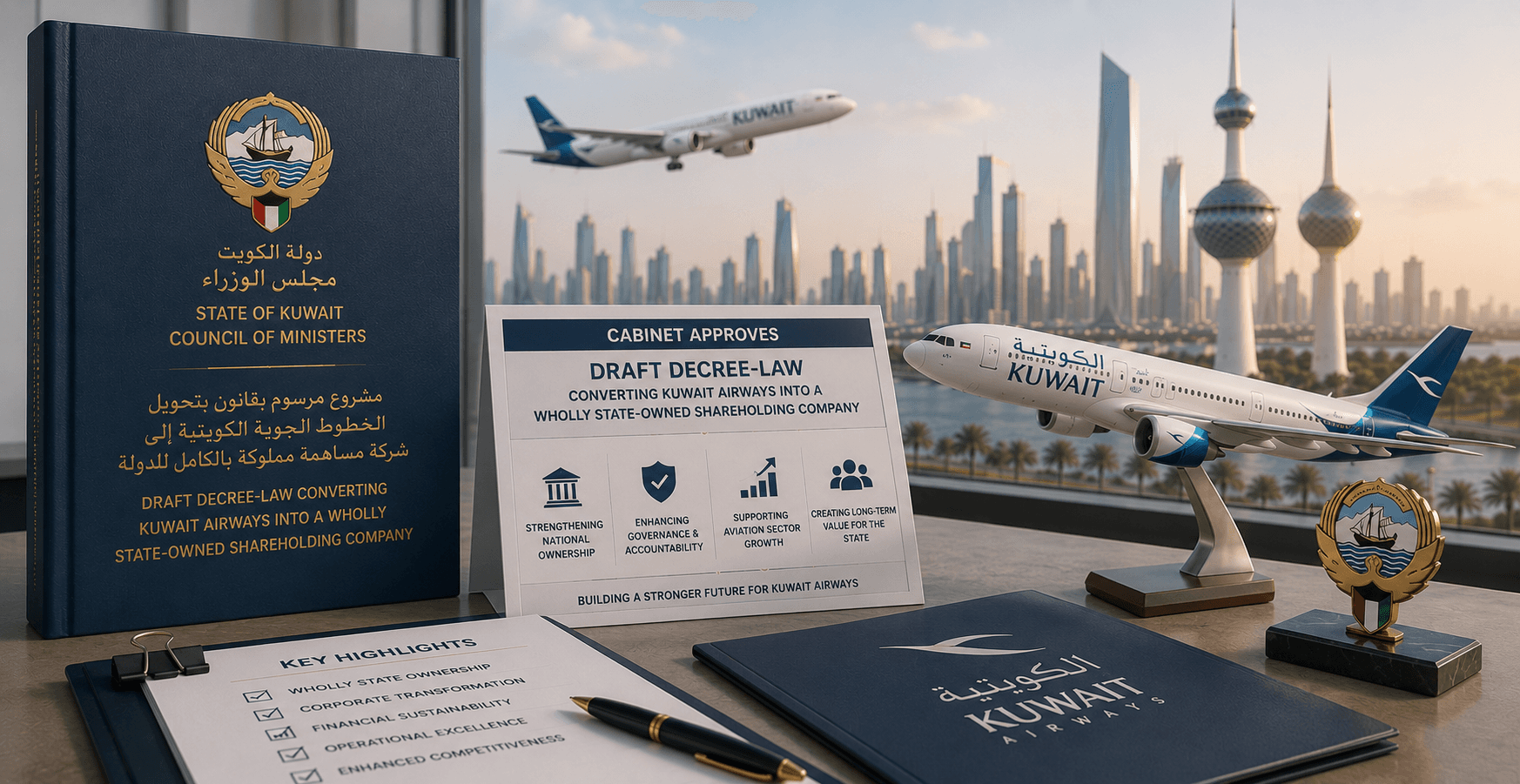
UPDATE: Decree-Law No. 77 of 2026 Gazetted, Converting Kuwait Airways Into a Wholly State-Owned Shareholding Company
Kuwait AirwaysKuwait Investment AuthorityState-Owned EnterprisesCorporatisation

UPDATE: Decree-Law No. 77 of 2026 Gazetted, Converting Kuwait Airways Into a Wholly State-Owned Shareholding Company

Decree-Law No. 77 of 2026 was issued on 28 July 2026 and published in Kuwait Al-Youm, Supplement to Issue 1801, dated 29 July 2026. Under Article 11 it takes effect from the date of publication. Proposed by the Minister of State for Economic Affairs and Investment, it completes the step WEFAQ reported on 20 July 2026. Article 1 makes Kuwait Airways Company a Kuwaiti shareholding company wholly owned by the State, carrying on business under its memorandum and articles of association and Companies Law No. 1 of 2016. State ownership of the whole share capital remains direct, and no disposal in any form is permitted without Council of Ministers approval. Article 2 vests the powers of the ordinary and extraordinary general assembly in the Board of Directors of the Kuwait Investment Authority. Article 3 allows the board, whose members that general assembly selects, to issue the administrative, financial, staff, tender, auction and procurement regulations without being bound by Decree-Law No. 105 of 1980 on the State Property System or Public Tenders Law No. 49 of 2016. Article 6 disapplies Competition Law No. 72 of 2020 to the company's activities. Article 7 confines the Audit Bureau to studying and commenting on the auditor's reports and financial statements. Article 10 repeals Law No. 6 of 2008 and any conflicting provision. WEFAQ's view: this is corporatisation completed, not privatisation, and the same legal person continues: Article 8 requires the company's status and constitutive documents to be conformed, not assets transferred. Counterparties should still check consent and notification clauses, and note that the carrier now sits outside both the public tendering and competition regimes. Read more: for the full analysis, read our companion blog article: “K uwait Airways Under Decree-Law No. 77: Outside Public Tenders, Outside Competition Law ”.

Learn more
Ministry of Justice Issues New Notarization Regulations: Remote Notarization Goes Live and Private Notaries Arrive
NotarizationMinistry of JusticeE-GovernmentPowers of Attorney

Ministry of Justice Issues New Notarization Regulations: Remote Notarization Goes Live and Private Notaries Arrive

The Minister of Justice, Counsellor Nasser Yousef Al-Sumait, issued Decision No. 590 of 2026 on 28 July 2026, promulgating new Executive Regulations for the Notarization Law No. 10 of 2020 as amended by Decree-Law No. 147 of 2025. The Regulations repeal Decision No. 348 of 2021, run to sixty articles with three schedules, and apply from the date of issue. The centrepiece is a complete electronic track. Notarization and attestation may now be carried out by recorded video session, with identity verified through the Hawiyati digital ID, a protected electronic signature or sight of the civil ID on camera (Articles 17 to 22). Routine special powers of attorney listed in Schedule 1 can be completed through a fully automated system with no notary intervention, under the Department's electronic seal and at the same fees as in-person service (Article 19). Remote channels are closed to persons with a mental disability, persons aged seventy-five or above, and those under judicial assistance (Article 18). The Regulations also operationalize the private notary profession created by Decree-Law No. 147 of 2025. Licensed private notaries may notarize powers of attorney of all kinds except those relating to real-estate ownership or real rights, notarize company incorporation, amendment, dissolution and exit contracts, attest signatures and certify dates (Article 39). Licences run for two renewable years and require Kuwaiti nationality, a law degree, ten years of legal experience and professional indemnity cover of at least KD 100,000; Schedule 2 caps fees, including KD 100 for a company contract (Articles 40, 44 and 47). Notarized powers of attorney are now valid for five years, or ten years for litigation powers granted to registered lawyers and powers used exclusively outside Kuwait, and the expiry date must appear on the deed itself (Article 16). WEFAQ's view: the Regulations take effect immediately, so the practical changes begin today. Businesses should record the new validity limits against existing powers of attorney and expect banks, counterparties and government bodies to start asking when a notarized power expires. Read more: for the full analysis, read our companion blog article: " Kuwait's New Notarization Regime: Remote Deeds, Private Notaries and a Five-Year Clock on Powers of Attorney ". Source: Ministry of Justice Decision No. 590 of 2026, dated 28 July 2026 (certified copy, Ministry of Justice, General Registration Section); publication in Kuwait Al-Youm pending. This article is provided for general information only and does not constitute legal advice. For advice specific to your circumstances, please contact WEFAQ Law Firm.

Learn more

Wefaq Law Firm Launches Bilingual Kuwait Contract Templates
WefaqTemplates

Wefaq Law Firm Launches Bilingual Kuwait Contract Templates

Wefaq Law Firm has launched Wefaq Templates, a collection of bilingual (Arabic/English) employment and HR contract templates drafted to comply with Kuwait Labour Law No. 6 of 2010. The first release, The Hiring Pack, is available now at wefaqlaw.com/templates. The Hiring Pack contains nine documents covering the employee lifecycle from hire to exit, including unlimited- and limited-term employment contracts, a non-disclosure agreement, a consultancy agreement, resignation and termination letters, a settlement and final release, and asset handover and return forms. Each template is drafted in Arabic and English side by side, and is supplied with a usage guide, a compliance note, and free updates for 12 months if the underlying law changes. To let businesses assess the drafting before buying, the firm is offering a free single-page bilingual Mutual NDA in exchange for an email address. Templates are sold individually from 15 KWD, or as a full bundle for 220 KWD, about 25% below the combined price, which includes a complimentary one-hour consultation. “Businesses in Kuwait deserve documents that are actually written for Kuwait law, in both Arabic and English,” said Bader Alqellaish of Wefaq Law Firm. “That is what we set out to provide, clear, compliant templates, with tailored drafting available when a situation calls for it.” Wefaq Templates are legal information products and not a substitute for legal advice. More information is available at wefaqlaw.com/templates.

Learn more
Ministry of Finance Sets Document Prices and Grievance Fees for Purchase Unit Procurement at the Central Agency for Public Tenders
Public ProcurementCentral Agency for Public TendersMinistry of FinanceTender Grievances

Ministry of Finance Sets Document Prices and Grievance Fees for Purchase Unit Procurement at the Central Agency for Public Tenders

The Minister of Finance issued Ministerial Decision No. 35 of 2026 on 16 July 2026, fixing the sale prices of tender and practice documents and the fees for grievances against the Purchase Unit and the Purchase Committee at the Central Agency for Public Tenders (CAPT). The decision was published in Kuwait Al-Youm Issue 1801 on 26 July 2026 and takes effect from the date of publication. The decision rests on the Public Tenders Law No. 49 of 2016 and its Executive Regulations issued by Decree No. 30 of 2017. It follows Decree No. 32 of 2026, issued on 24 February 2026, which attached CAPT to the Minister of Finance, and a Ministry of Finance approval of the proposed fees conveyed by letter No. 11206/2026 dated 10 May 2026. Article 1 sets document prices in four tiers by estimated value: KD 10 for purchases below KD 2,000, KD 20 for values up to KD 5,000, KD 30 for values up to KD 30,000, and KD 50 for values up to KD 75,000. These bands cover low-value procurement conducted through CAPT's internal purchase channels; contracts above KD 75,000 remain subject to the full tender procedures of Law No. 49 of 2016. Article 2 introduces filing fees for grievances: KD 250 for grievances concerning prequalification, KD 125 for requests to add a company to a limited practice, and KD 500 or KD 1,000 for challenges to practice procedures, depending on whether the estimated value sits between KD 5,000 and KD 30,000 or between KD 30,000 and KD 75,000. Article 3 repeals any conflicting provisions. WEFAQ's view: suppliers and contractors competing for low-value government purchases should treat the new fees as part of their bid economics and diarise the grievance route. A priced challenge mechanism tends to filter out casual objections while giving serious bidders a clearer procedural path. Source: Ministerial Decision No. 35 of 2026; Kuwait Al-Youm Issue 1801, dated 26 July 2026. This article is provided for general information only and does not constitute legal advice. For advice specific to your circumstances, please contact WEFAQ Law Firm.

Learn more

KOC Signs US$16 Billion Pipeline Infrastructure Partnership with Blackstone, Brookfield and KKR
KPCForeign Direct InvestmentJoint VenturesEnergy Infrastructure

KOC Signs US$16 Billion Pipeline Infrastructure Partnership with Blackstone, Brookfield and KKR

Kuwait Petroleum Corporation announced on 25 July 2026 that its wholly owned subsidiary, Kuwait Oil Company, has signed a US$16 billion lease-and-leaseback agreement over its crude oil pipeline network with a consortium of Blackstone, Brookfield and KKR. KPC describes the transaction, known as Project Peregrine, as the largest foreign direct investment in Kuwait's history. The structure places 13 pipelines, spanning approximately 320 kilometres, into a newly incorporated Kuwaiti joint venture in which KOC holds 51 per cent and the three investors hold 49 per cent between them in equal proportions. The joint venture leases the usage rights from KOC and grants back exclusive use, operation and maintenance rights for 20.5 years against a volume-based tariff. KOC retains full ownership and operational control, and the arrangement imposes no restriction on refining throughput or production volumes, which remain matters for the State. Upfront proceeds on closing are expected to be US$7.85 billion, directed to KPC's capital expenditure programme and its target of four million barrels per day of crude production capacity by 2035. The agreement is governed by Kuwaiti law and remains subject to customary closing conditions and regulatory approvals. Centerview Partners, HSBC and J.P. Morgan advised KPC. Deputy Chairman and Chief Executive Officer Shaikh Nawaf Saud Al-Sabah said the transaction delivers on the commitment made at the Kuwait Oil & Gas Show in February 2026 to bring international investors into strategic infrastructure while preserving national ownership and operational control. WEFAQ's view: the transaction follows closely on Decree-Law No. 67 of 2026, which restated KPC as an institution managed on commercial bases, confirmed its powers to incorporate and restructure subsidiaries, and lifted certain prior-control requirements. Counterparties and suppliers across the KPC group should expect the joint venture model to be tested again on other asset classes. Read more: for the full analysis of the legal architecture behind the transaction and what it signals for foreign investment in Kuwaiti strategic assets, read our companion blog article: ' From Decree-Law No. 67 to Project Peregrine: The Legal Architecture Behind Kuwait's Largest Inward Investment '.

Learn more
Kuwait's US$6 Billion Sovereign Bond Sale Draws Order Book Above US$18 Billion
Sovereign BondsMinistry of FinanceFinancing & Liquidity LawDebt Capital Markets

Kuwait's US$6 Billion Sovereign Bond Sale Draws Order Book Above US$18 Billion

The Ministry of Finance announced on 23 July 2026 the completion of the State of Kuwait's US$6 billion three-tranche sovereign bond issuance, after global demand exceeded US$18 billion, more than three times the amount offered, notwithstanding heightened security conditions in the region. The issuance comprised US$3 billion of three-year notes priced at 70 basis points over US Treasuries, US$1.5 billion of five-year notes at 75 basis points, and US$1.5 billion of ten-year notes at 85 basis points. According to market commentary reported by Al-Rai, final pricing came approximately 25 basis points inside initial guidance, reflecting the strength of the order book. Allocations were geographically broad: approximately 48 per cent to investors in the Americas, 28 per cent to the United Kingdom and Europe, 16 per cent to the Middle East and North Africa, and 4 per cent to Asia. The transaction was executed under Decree-Law No. 60 of 2025 concerning Financing and Liquidity, which entered into force on 27 March 2025 and ended Kuwait's eight-year absence from international debt markets. The law sets a public borrowing ceiling of KD 30 billion and permits sovereign instruments, including bonds and sukuk, with maturities of up to fifty years. Economists quoted in the Kuwaiti press noted that proceeds will help finance the budget deficit and ease pressure on the General Reserve Fund, particularly amid the temporary disruption to crude oil exports. The issuance complements the secondary-market infrastructure now operating at Boursa Kuwait, whose dedicated bonds and sukuk platform — covered by WEFAQ in June — commenced operations following Capital Markets Authority approval. WEFAQ's view: the outcome restores a full sovereign US-dollar reference curve at three, five and ten years, giving Kuwaiti banks and corporates a pricing benchmark for their own issuances and confirming that the Decree-Law No. 60 of 2025 framework is functioning as designed. Prospective issuers should begin assessing documentation and disclosure readiness now. Read more: for the full analysis of what the issuance means for issuers and investors, read our companion blog article: ' Kuwait's Sovereign Benchmark Is Back: What the US$6 Billion Issuance Means for Issuers and Investors' .

Learn more
Kuwait Issues Decree-Law No. 72 of 2026 Regulating the Establishment and Management of Places of Worship
Places of WorshipPublic LawLicensingRegulatory Compliance

Kuwait Issues Decree-Law No. 72 of 2026 Regulating the Establishment and Management of Places of Worship

Decree-Law No. 72 of 2026, promulgating the Law on the Regulation of the Establishment and Management of Places of Worship, was issued at Seif Palace on 12 July 2026 and published in Kuwait Al-Youm Issue 1800, dated 19 July 2026, taking effect on publication. Places of worship established or managed by the Ministry of Awqaf and Islamic Affairs fall outside its scope. The law comprises thirty articles in six chapters. A prior licence from the competent minister, issued on the recommendation of a dedicated Places of Worship Committee, is now required to establish, elevate, expand, reinforce, renovate, manage or demolish a place of worship (Articles 11–16), and a licensed place of worship acquires legal personality from the date its licence is issued. The financial-governance provisions are notable. Every place of worship must maintain an account with a local bank subject to Central Bank of Kuwait supervision, into which all of its financial resources must be deposited, with the account overseen by the competent unit at the ministry. Records, books and electronic systems must be retained at the place of management for no less than ten years. The preamble's citations of the Anti-Money Laundering Law No. 106 of 2013 and the 1959 law on licensing public fundraising signal a clear donations-transparency agenda. On enforcement, designated ministry employees hold judicial-officer status, the Public Prosecution has exclusive competence to investigate and prosecute offences under the law (Articles 23–29), and a ministry committee will hear grievances against decisions issued under it (Article 30). The Cabinet must issue executive regulations within six months of publication. Existing places of worship then have six months from the regulations' effective date to regularize their status; the competent ministry may close non-compliant premises and liquidate their assets, returning funds to their owners unless impossible, or assume or assign their management. WEFAQ advises legal representatives of existing congregations, and the charities and property owners that host them, to map the licensing, banking and record-keeping requirements now rather than await the executive regulations, given the short regularization window that will follow them. Source: Decree-Law No. 72 of 2026, Kuwait Al-Youm Issue 1800, dated 19 July 2026. This article is provided for general information only and does not constitute legal advice. For advice specific to your circumstances, please contact WEFAQ Law Firm.

Learn more

Cabinet Approves Draft Decree-Law Converting Kuwait Airways Into a Wholly State-Owned Shareholding Company
Kuwait AirwaysState-Owned EnterprisesCorporatisationCouncil of Ministers

Cabinet Approves Draft Decree-Law Converting Kuwait Airways Into a Wholly State-Owned Shareholding Company

At its meeting on Tuesday 14 July 2026, chaired by the Prime Minister Sheikh Ahmad Al-Abdullah Al-Ahmad Al-Sabah, the Council of Ministers approved a draft decree-law transforming Kuwait Airways Corporation into a shareholding company wholly owned by the State. The Deputy Prime Minister and Minister of State for Cabinet Affairs, Shareeda Al-Maousherji, confirmed after the session that the draft has been referred to His Highness the Amir Sheikh Meshal Al-Ahmad Al-Jaber Al-Sabah for final approval. The instrument had not been issued or gazetted as at the date of this note, and its operative text is therefore not yet public. The significance lies in what changes and what does not. The proposal alters the carrier's legal form — from a public corporation to a shareholding company, with the share capital, board and governance architecture that form brings — while leaving ownership entirely with the State. That is corporatisation, not privatisation, and it is a deliberate departure from the earlier statutory direction: Law No. 6 of 2008, as subsequently amended, contemplated conversion into a shareholding company accompanied by a strategic investor stake and a public offering, leaving the State a minority holder. That framework was never brought to completion. Several points will only be answerable once the decree-law is published. Chief among them are the company's authorised and issued capital and who subscribes it; the mechanism transferring the Corporation's assets, liabilities, contracts and licences to the new entity; the treatment of existing employees and their accrued entitlements; the governance model and the extent of ministerial oversight retained; the position of Law No. 6 of 2008 and whether it is repealed; and any transitional period before the conversion takes effect. WEFAQ's view: Counterparties should read this as a change of corporate personality rather than a change of control. Suppliers, lessors, financiers and code-share partners contracting with the Corporation should identify now whether their agreements contain change-of-entity, assignment or novation provisions that a statutory transfer would engage, and whether any consent or notification is triggered. Well-drafted statutory conversions usually carry universal succession language that preserves existing contracts, but that is a matter for the decree-law's text, which is not yet available. We will report on the operative provisions once the instrument is gazetted.

Learn more
Kuwait's CMA Opens Foreign Fund Marketing to Investment Advisors in Resolution 95 of 2026
CMACollective Investment SchemesInvestment AdvisorsExecutive Bylaws

Kuwait's CMA Opens Foreign Fund Marketing to Investment Advisors in Resolution 95 of 2026

The Capital Markets Authority published two amending resolutions in the Official Gazette on 19 July 2026 (Kuwait Al-Youm, Issue 1800, pages 34–40). Resolution No. 95 of 2026 amends Book One (Definitions) and Book Five (Securities Activities and Registered Persons) of the Executive Bylaws of Law No. 7 of 2010, and Resolution No. 96 of 2026 amends Book Ten (Disclosure and Transparency). Both were made on the resolution of the Board of Commissioners at its meeting No. 28 of 2026 held on 8 July 2026, were signed by the Chairman of the Board of Commissioners, Emad Ahmed Tayfouni, on 9 July 2026, and take effect from their date of issue. The substantive change sits in the definition of "Marketer" in Book One. As previously drafted, a Marketer was a person licensed by the Authority to carry on the activity of collective investment scheme manager or subscription agent (sale) who markets units of a foreign collective investment scheme in Kuwait after obtaining the Authority's permission. The amended definition adds "or investment advisor" to that list. An investment-advisor licence is therefore now capable of supporting the marketing of foreign fund units in Kuwait, subject as before to the Authority's permission. The Book Five amendment is technical. Article 1-43-3, which sets out what a person wishing to carry on the activity of qualified securities broker registered on the securities exchange must provide to the Authority, is revised so that its opening cross-reference cites Article (1-43-2) alongside Article (1-42-2), and refers expressly to the Bylaws. Resolution No. 96 of 2026 amends Article 4-1-1 of Book Ten, the provision requiring a listed company to make timely disclosure of material information concerning it; the revised wording is set out in the comparison annex to that resolution. WEFAQ's view : Widening the Marketer definition is a small drafting change with a real licensing consequence: firms holding an investment-advisor licence no longer need to sit outside the foreign-fund distribution chain, and the population of entities able to place offshore fund units with Kuwaiti investors grows accordingly. Advisory firms considering that step should note that the Authority's separate permission for the specific scheme remains a precondition, and that the marketing conduct and disclosure obligations attaching to the activity are unchanged. • • • Source: Kuwait Al-Youm, Issue 1800, pages 34–40 (Capital Markets Authority Resolutions No. 95 and No. 96 of 2026, with their comparison annexes), dated 19 July 2026; Law No. 7 of 2010 and its Executive Bylaws. This article is provided for general information only and does not constitute legal advice. For advice specific to your circumstances, please contact WEFAQ Law Firm.

Learn more

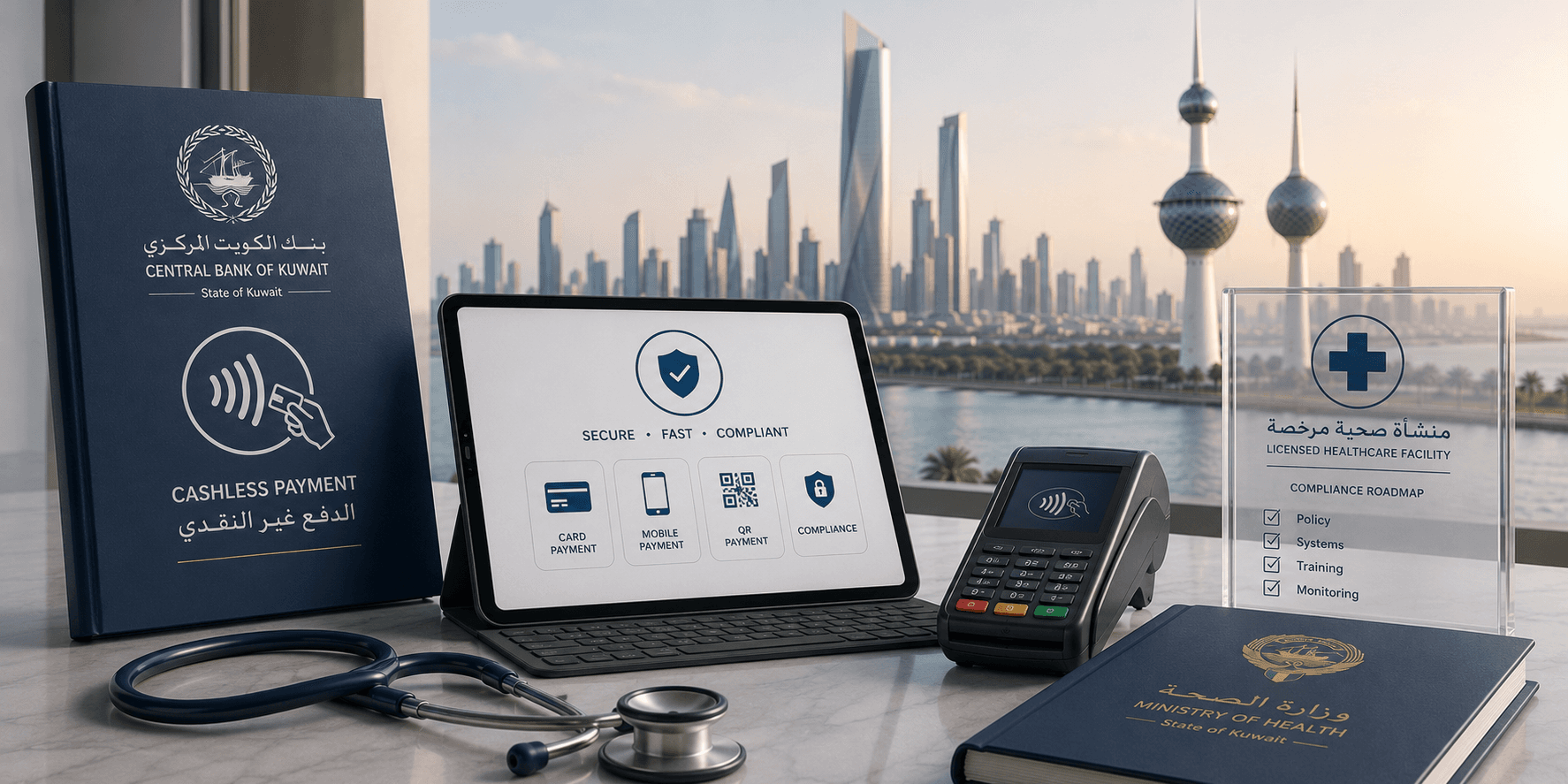
Kuwait Caps Cash at KD 10 Across Licensed Private Healthcare, With Closure and Criminal Referral for Breach
MOCICashless PaymentsAML CompliancePrivate Healthcare

Kuwait Caps Cash at KD 10 Across Licensed Private Healthcare, With Closure and Criminal Referral for Breach

On 12 July 2026 the Minister of Commerce and Industry, Osama Khaled Abdullah Boodai, issued Ministerial Decision No. 110 of 2026 on the prohibition of cash transactions by companies in certain activities, published in the Official Gazette (Kuwait Al-Youm, Issue 1800, page 13) on 19 July 2026. Article One obliges every company owning a private health facility licensed by the Ministry of Health — including hospitals, medical centres, clinics, home healthcare providers and other licensed private medical establishments — not to conduct any cash transaction exceeding KD 10 when collecting fees for its services. Payments above that threshold must be made through the banking channels and electronic payment services approved by the Central Bank of Kuwait. The sanction is unusually direct. Without prejudice to any other measure or penalty provided in related laws, Article Two applies the penalties set out in Decree-Law No. 10 of 1979 on the supervision of trade in goods, services and handicrafts, and provides that any establishment breaching Article One shall be closed and referred to the competent investigation authorities. A further article repeals any conflicting provision in any other decision. The decision takes effect from its date of issue rather than from gazette publication, so the obligation has been live since 12 July 2026. The decision is the second instalment of a sector-by-sector cash ceiling rather than a standalone measure. In April 2026 the same ministry issued Ministerial Decision No. 32 of 2026, applying an identical KD 10 limit — and the same closure-and-referral sanction — to health institutes, men's, women's and children's salons, sports clubs, pest control companies, and businesses importing, exporting or storing public health pesticides. The recitals to Decision 110 cite the anti-money laundering law (Law No. 106 of 2013), the Commercial Shop Licences Law as amended by Decree-Law No. 162 of 2025, the Consumer Protection Law and the Companies Law, alongside a Ministry of Health letter of 30 March 2026. WEFAQ's view: At KD 10 this is not a cap on cash but a cashless mandate — a routine consultation fee already clears the threshold. The exposure is operational rather than financial: the sanction is closure and referral to the investigation authorities, not a fine calibrated to turnover, and it attaches to the licence-holding company. Operators should treat point-of-sale readiness, CBK-approved payment channel contracts and front-desk instructions as an immediate compliance item, and should assume the schedule of covered activities will keep expanding. • • • Source: Kuwait Al-Youm, Issue 1800, page 13 (Ministry of Commerce and Industry, Ministerial Decision No. 110 of 2026 on the prohibition of cash transactions by companies in certain activities), dated 19 July 2026; Ministerial Decision No. 32 of 2026; KUNA, 7 April 2026. This article is provided for general information only and does not constitute legal advice. For advice specific to your circumstances, please contact WEFAQ Law Firm.

Learn more

Kuwait’s Capital Markets Authority Cancels Rasameel’s Securities Licence, Completing Its Merger by Absorption into KFIC Invest
CMAMerger by AbsorptionInvestment CompaniesCapital Markets

Kuwait’s Capital Markets Authority Cancels Rasameel’s Securities Licence, Completing Its Merger by Absorption into KFIC Invest

On 12 July 2026, Kuwait’s Capital Markets Authority (CMA) published, in the Official Gazette (Kuwait Al-Youm, Issue 1799, page 14), Resolution No. 94 of 2026 cancelling the securities-activities licence of Rasameel Investment Company and striking it from the CMA register of licensed persons. The step completes Rasameel’s merger by absorption into KFIC Invest (Kuwait Finance and Investment Company). The merger proceeds by way of absorption: Rasameel is dissolved and its entire estate (assets and liabilities alike) passes to KFIC Invest. The transaction was approved by the extraordinary general assemblies of KFIC Invest on 1 February 2026 and of Rasameel on 8 February 2026, annotated on the commercial register at the Ministry of Commerce and Industry on 24 March 2026, and cleared for execution by the CMA on 14 June 2026. Resolution No. 94 gives the licence cancellation effect from that commercial-register date. The same gazette issue carried two further CMA supervisory decisions: Resolution No. 92 of 2026, granting Watani Investment Company a private-placement licence to market up to USD 160 million of units in the Luxembourg-domiciled Lemania funds to professional clients only, and Resolution No. 93 of 2026, authorising Gulf Capital Investment Company to establish the open-ended Al-Badr Islamic Gulf Equities Fund. WEFAQ’s view: A merger by absorption is only complete once the regulatory perimeter catches up with the corporate steps. Here the assembly approvals and commercial-register annotation preceded the CMA’s licence cancellation by several months, and it is the deregistration that formally removes the absorbed firm from the market. Parties structuring the absorption of a CMA-licensed or CBK-registered entity should map the full sequence (assembly, then register, then regulator) into the closing timetable, and keep client-money, custody and reporting obligations live until the licence is actually cancelled. Source: Kuwait Al-Youm, Issue 1799, page 14 (Capital Markets Authority Resolutions No. 92, 93 and 94 of 2026), dated 12 July 2026. This article is provided for general information only and does not constitute legal advice. For advice specific to your circumstances, please contact WEFAQ Law Firm.

Learn more

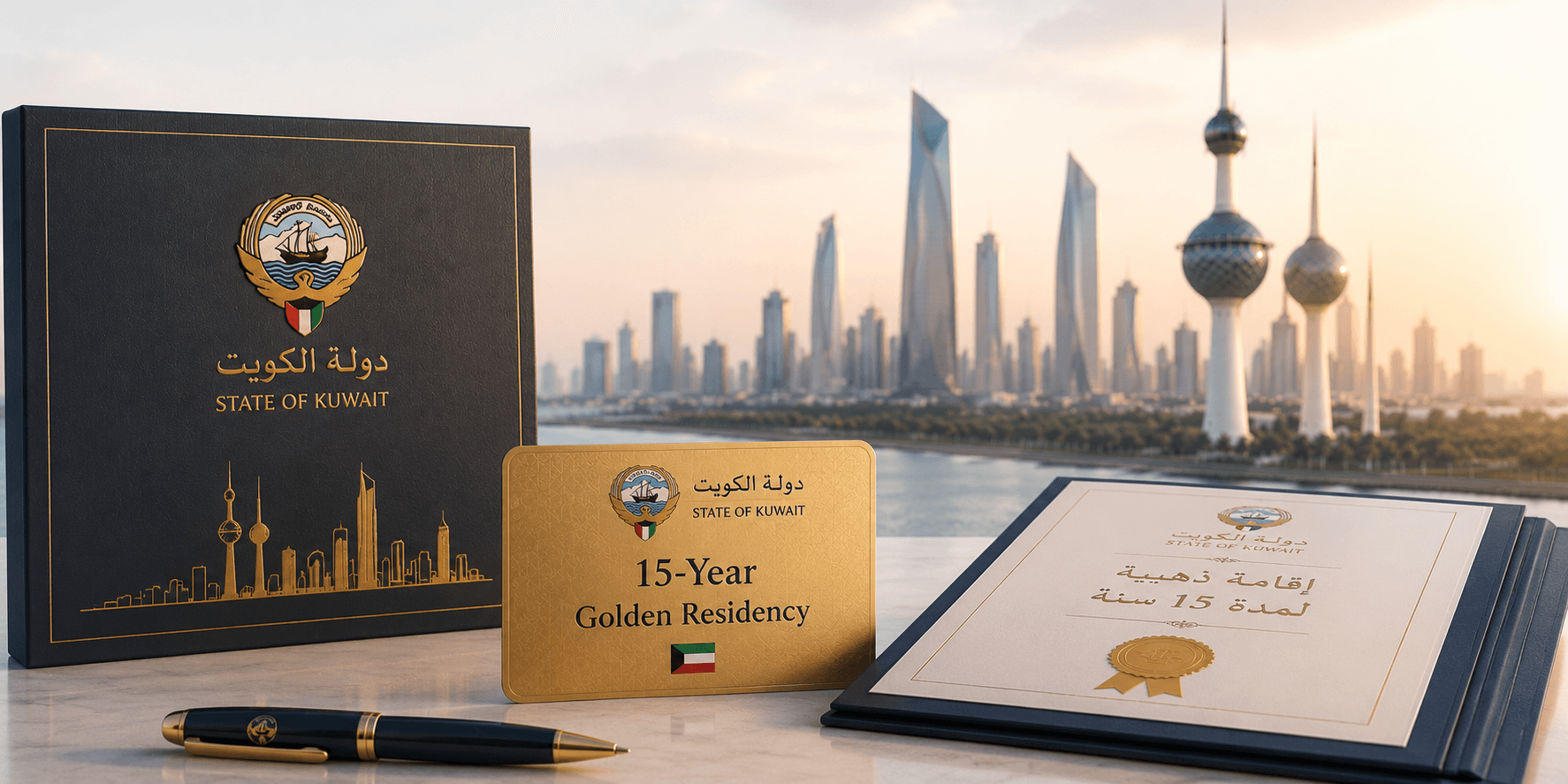
Kuwait Grants Its First 15-Year Golden Residency, to Lulu Group Chairman Yusuff Ali M.A.
KDIPAGolden ResidencyResolution 651/2026Foreign Direct Investment

Kuwait Grants Its First 15-Year Golden Residency, to Lulu Group Chairman Yusuff Ali M.A.

On 14 July 2026, Kuwait issued its first Golden Residency, the investor residency valid for up to 15 years, when First Deputy Prime Minister and Minister of Interior Sheikh Fahad Yusuf Saud Al-Sabah presented the permit to Yusuff Ali M.A., chairman of Lulu Group International. It is the first grant under the framework WEFAQ reported on 18 June 2026 ( Cabinet Resolution No. 651 of 2026 ), and comes days after the scheme opened for applications on 8 July 2026. The scheme, adopted under Law No. 116 of 2013 on the Promotion of Direct Investment, allows the Ministry of Interior's General Directorate of Residency Affairs to grant residency of up to 15 years on referral from the Kuwait Direct Investment Promotion Authority (KDIPA). It is open to owners, partners and KDIPA-approved senior managers of qualifying investment entities, together with their immediate families, where the total investment is at least KD 5 million and the entity's capital at least KD 1 million. The Ministry said the framework was developed with KDIPA and the Public Authority for Civil Information (PACI) around standards aligned with international best practice. The first issuance is a statement of intent as much as an administrative step: it moves the programme from text to practice within days of launch, and does so with a prominent regional investor. The government framed the initiative as part of its drive to attract high-quality capital and to position Kuwait as a competitive investment hub, bringing it into line with GCC peers that use long-term “golden” residency to compete for investors and their families. WEFAQ's view: With the first permit issued, attention turns to execution — how quickly KDIPA clears complete files against the Resolution's five-working-day target, how the KD 5 million investment and KD 1 million capital tests are evidenced, and how the licensing and residency tracks are sequenced. Investors weighing Kuwait should run both workstreams together and assemble KDIPA-ready documentation now, while the programme is new and the authorities are actively championing it.

Learn more
Kuwait Caps Delivery-Platform Commissions at 17% and Delivery Fees at One Dinar
MOCIDigital CommerceDelivery PlatformsConsumer Protection

Kuwait Caps Delivery-Platform Commissions at 17% and Delivery Fees at One Dinar

On 12 July 2026 the Official Gazette (Kuwait Al-Youm, Issue 1799( published Ministerial Decision No. 109 of 2026 of the Minister of Commerce and Industry, issuing the Regulation Organising the Sector of Intermediary Electronic Platforms and Applications for Displaying, Ordering and Delivering Products to Consumers. Signed on 8 July 2026, the Regulation implements Decree-Law No. 10 of 2026 on the Digital Commerce Sector and repeals the earlier restaurant-and-ready-food delivery regulation (Ministerial Decision No. 10 of 2026), widening the rules from food delivery to every intermediary platform. Scope. The Regulation applies to all intermediary electronic platforms operating in Kuwait that broker purchase orders between a merchant (the “client”) and consumers and coordinate delivery or collection of the order value, whatever the merchant’s activity, provided the merchant is licensed. Platforms that sell only their own products, without intermediating third-party goods, fall outside it. The centrepiece is Article 7. The total a platform may charge a merchant — commission plus any advertising, promotion, premium or paid placement, priority ranking, and the platform’s own delivery service — may not exceed 17% of the order value (before the delivery fee), per order; where the merchant delivers by its own means, the ceiling falls to 10%. A platform may not compel a merchant to use the platform’s delivery service, nor penalise self-delivery. The consumer alone bears the delivery fee, capped at one Kuwaiti dinar (KD 1) per order, with no additional charge under any name. Providers must reclassify their commercial-register activity to “Management of Delivery Services via Electronic Platforms” (international classification 532013) and bring existing merchant contracts into conformity before 1 September 2026 — except contracts already within the Article 7 ceiling, which may run to expiry. Providers must also observe the Competition Protection Agency’s guidance manual (Decision No. 1 of 2026) on prohibited practices, and face the penalties in Article 15. WEFAQ’s view: platforms and the restaurants, pharmacies and retailers that sell through them should re-paper their commercial agreements now. The 1 September deadline is short, and the commission and delivery-fee ceilings change the economics of every order. For more information, see our blog article , which offers a deeper analysis of this topic. This article is provided for general information only and does not constitute legal advice. For advice specific to your circumstances, please contact WEFAQ Law Firm.

Learn more

Kuwait's Competition Agency Clears Eight Cross-Border Deals in a Single Session
Kuwait Merger ControlCompetition Protection AgencyCross-border M&ARegulatory

Kuwait's Competition Agency Clears Eight Cross-Border Deals in a Single Session

On 5 July 2026 the Official Gazette (Kuwait Al-Youm, Issue 1798, pages 6 to 10 of the issue's second pagination sequence) published eight clearance decisions of the Board of Directors of the Competition Protection Agency (Decisions Nos. 67 to 74 of 2026). All eight were adopted at board meeting No. 114 held on 23 June 2026, signed on 28 June 2026, and approve economic concentrations under Law No. 72 of 2020 on the Protection of Competition and its Executive Regulations (Decision No. 14 of 2021). The cleared transactions are: · Decision 67/2026: Motion JV Co Limited's acquisition of 100% of Castrol Group Holdings Limited (file CPACNM000222026), the vehicle for Stonepeak's publicly reported 65/35 joint venture with bp over the Castrol lubricants business. · Decision 68/2026: Lin Yin International Investments Ltd, wholly owned by Hon Hai Precision Industry (Foxconn), acquiring 50% of Mitsubishi Fuso Bus Manufacturing Ltd from Mitsubishi Fuso Truck and Bus Corporation (file CPACNM000252026). · Decision 69/2026: Kimberly-Clark Corporation's acquisition of all shares of Kenvue Inc. through the merger of Vista Sub 1 Inc. and Vista Sub 2 LLC with Kenvue (file CPACNM000142026). · Decision 70/2026: Prince Sub, owned by Paramount Skydance Corporation (USA), acquiring 100% of Warner Bros. Discovery Inc. (file CPACNM000172026). · Decision 71/2026: Volkswagen Finance Luxembourg S.A., through Europcar Holding Luxembourg S.A., acquiring a further 27% of Green Mobility Holding S.A., raising its stake to 93% and achieving sole control (file CPACNM000192026). · Decision 72/2026: East Gate Games Investment Company (Saudi Arabia) acquiring 100% of Moonton Holding Ltd (Cayman Islands) and 100% of Shanghai Muton Technology Co. from ByteDance Ltd (file CPACNM000202026). · Decision 73/2026: Dubai Aerospace Enterprise (DAE), through DAE Aircam Designated Activity Company, acquiring all shares of Macquarie AirFinance Ltd (file CPACNM000212026). · Decision 74/2026: Turkish Airlines (Türkiye) acquiring 26.95% of Air Europa Holding (Spain) (file CPACNM000242026). All eight approvals were published without conditions. None of the target businesses is incorporated in Kuwait: the batch confirms the Agency's steady throughput on foreign-to-foreign transactions that meet the Kuwaiti filing thresholds. WEFAQ's view : parties to international M&A with sales into Kuwait should treat a Kuwaiti filing as a standing item on the global merger-control checklist, not an afterthought. Source: Kuwait Al-Youm, Issue 1798, pages 6 to 10 (second pagination sequence), dated 5 July 2026 (Decisions Nos. 67 to 74 of 2026, signed 28 June 2026). This article is provided for general information only and does not constitute legal advice. For advice specific to your circumstances, please contact WEFAQ Law Firm.

Learn more

Kuwait's CMA Unveils “Additional Financial Services”: Margin-Trading Regime, Interest-Bearing Client Cash and an Inducements Ban
CMAMargin TradingClient Money RulesCapital Markets

Kuwait's CMA Unveils “Additional Financial Services”: Margin-Trading Regime, Interest-Bearing Client Cash and an Inducements Ban

On 5 July 2026 the Official Gazette (Kuwait Al-Youm, Issue 1798, pages أ40 onward) published Capital Markets Authority Board of Commissioners Resolution No. 85 of 2026 on “Additional Financial Services,” signed by the Chairman of the Board of Commissioners, Emad Ahmed Tayfoun, on 25 June 2026. The resolution amends Annex No. 4 (the schedule of Authority service fees) of Book Two, together with Book Seven (Client Money and Assets), Book Eight (Business Conduct) and Book Eleven (Dealing in Securities) of the Executive Regulations of Law No. 7 of 2010. The resolution delivers three reforms. A new Article 1-2-2 of Book Seven lets a licensed person deposit a client’s trading cash into interest- or profit-bearing accounts at locally licensed banks—subject to the client’s prior consent, full segregation, periodic return statements and liquidity sufficient for immediate repayment. A new Article 6-1 of Book Eight bars brokers and their staff from paying or receiving inducements to or from clients, save for symbolic gifts, genuine service costs and regulated brokerage discounts. Book Eleven then codifies a prudential margin-trading regime. Under that regime, the initial margin must be at least 50% and the maintenance margin at least 25% of the market value of the financed securities; financing is capped at 25% of the service’s funds per security and 10% per client; providers must run Ci-Net creditworthiness checks and report weekly to the CMA on the ratios and to the Central Bank of Kuwait on client credit. On default, the provider may sell the pledged securities without being bound by Articles 231 to 233 of the Commercial Law. The Book Eleven margin-trading amendments took effect on the resolution’s issuance (25 June 2026); the remaining amendments apply once the CMA issues its new commissions-and-fees structure. WEFAQ’s view : brokers and investment firms should refresh client agreements, client-money segregation controls and regulatory-reporting pipelines now, ahead of the new fee structure. Source: Kuwait Al-Youm, Issue 1798, pages أ40–أ46, dated 5 July 2026 (Resolution No. 85 of 2026 signed 25 June 2026). This article is provided for general information only and does not constitute legal advice. For advice specific to your circumstances, please contact WEFAQ Law Firm.

Learn more

Kuwait Issues Four Decree-Laws Reshaping the Composition of Its Specialized Courts
Specialized CourtsBankruptcy LawCapital Markets AuthorityDispute Resolution

Kuwait Issues Four Decree-Laws Reshaping the Composition of Its Specialized Courts

On 5 July 2026 the Official Gazette (Kuwait Al-Youm, Issue 1798) published four decree-laws, Nos. 68 to 71 of 2026, all signed on 28 June 2026, that recalibrate how Kuwait's specialized judicial circuits are staffed. The common thread is a relaxation of the judicial-grade thresholds that had constrained the formation of these circuits, so that a court's General Assembly can complete their composition and dispose of cases without avoidable delay. Decree-Law No. 68 of 2026 amends the first paragraph of Article 297 of the Civil and Commercial Procedure Code (issued by Decree-Law No. 38 of 1980). The power to issue a travel-ban order against a debtor, previously confined to the deputies of the court, may now be assigned to any Court of First Instance judge selected by its General Assembly, curing delays caused by the scarcity of judges at deputy grade. Decree-Law No. 69 of 2026 amends Articles 4 and 7(1) of the Bankruptcy Law (Law No. 71 of 2020). Each circuit of the Bankruptcy Court may now comprise three judges chosen by the General Assembly, provided the circuit president is of at least court-deputy grade, and the Bankruptcy Administration may be headed by a judge of court-deputy grade, assisted by auditors drawn from the register held by the Capital Markets Authority. Decree-Law No. 71 of 2026 amends items (1) and (2) of Article 108 of the Capital Markets Authority Law (Law No. 7 of 2010), lowering the required grade of one member of the Capital Markets Court's criminal and non-criminal circuits from counsellor to court-deputy. Decree-Law No. 70 of 2026 applies the same change to the juvenile court under the Juveniles Law (Law No. 111 of 2015). WEFAQ's view: decoupling circuit membership from narrow grade requirements should shorten the time needed to constitute bankruptcy and capital-markets benches, a practical gain for creditors, issuers, and litigants awaiting a hearing date. For more information, see our blog article , which offers a deeper analysis of this topic. Source: Kuwait Al-Youm Issue 1798, pages أ٢ to أ٦, dated 5 July 2026 (decree-laws signed 28 June 2026). This article is provided for general information only and does not constitute legal advice. For advice specific to your circumstances, please contact WEFAQ Law Firm.

Learn more

Kuwait's iFSAH System Becomes the Sole Disclosure-Filing Channel: CMA Circular No. 11 of 2026
iFSAHCMACapital MarketsXBRL

Kuwait's iFSAH System Becomes the Sole Disclosure-Filing Channel: CMA Circular No. 11 of 2026

The Capital Markets Authority (CMA) has set 1 July 2026 as the date from which regulated entities must file all disclosures through its electronic disclosure system. CMA Circular No. 11 of 2026, published via Boursa Kuwait, is addressed to all listed companies, licensed persons, collective investment schemes and investment funds under liquidation, auditors registered with the CMA, and market participants, and concerns the mechanism for submitting disclosures effective from 1 July 2026. The circular closes the transitional period for the legacy Boursa Kuwait disclosure route (the CIP-based channel), whose extended operating window ran to 1 July 2026. From that date, financial and non-financial disclosures are submitted through the CMA's XBRL-based “iFSAH” system, which has been the mandatory platform since 5 January 2025 and routes filings through dedicated gateways for financial statements, capital adequacy, general assemblies, and market disclosures. The change is procedural in form but market-wide in reach: every issuer, licensed firm, fund and registered auditor files through the same tagged-data platform. The disclosure obligations themselves continue to flow from the Capital Markets Law No. 7 of 2010 and its Executive Regulations; the circular fixes how, not whether, those disclosures reach the regulator. WEFAQ's view: entities still filing through the legacy channel should confirm iFSAH registration, user permissions and XBRL-tagging readiness now, because a first post-cutover filing that misses a periodic deadline carries the same consequences as any late disclosure. Source: CMA Circular No. 11 of 2026 (Boursa Kuwait, CMA Decisions & Circulars); CMA iFSAH electronic disclosure framework. Governing law: Capital Markets Law No. 7 of 2010 and its Executive Regulations.

Learn more
Kuwait's Competition Agency Publishes Respighi BidCo / Recordati Merger Filing; 15-Day Objection Window Opens
Merger ControlCompetition/AntitrustCross-border M&ARegulatory

Kuwait's Competition Agency Publishes Respighi BidCo / Recordati Merger Filing; 15-Day Objection Window Opens

On 28 June 2026, Kuwait's Competition Protection Agency (CPA) published, in the Official Gazette (Kuwait Al-Youm, Issue 1797, page 216), an economic-concentration application notifying the proposed acquisition by Respighi BidCo S.p.A. (Italy) of the entire share capital of Recordati Industria Chimica e Farmaceutica S.p.A. (Italy). Publication opens the statutory window for any interested party to lodge a reasoned objection. Recordati is the Milan-listed pharmaceutical group active in the research, development, manufacture and marketing of medicines; Respighi BidCo is a special-purpose vehicle. Under publicly announced terms, Respighi BidCo is the bid vehicle for a consortium led by CVC Capital Partners and Groupe Bruxelles Lambert (GBL), with funds connected to the Abu Dhabi Investment Authority and the Canada Pension Plan Investment Board, and with Recordati's chairman expected to roll over his stake. The consortium has launched a voluntary tender offer for 100% of Recordati's ordinary shares at around EUR 52 per share, valuing the company at approximately EUR 10.7 billion, and intends to delist it from Euronext Milan. The filing is made under Law No. 72 of 2020 on the Protection of Competition and Article 83 of its Executive Regulations (issued by Resolution No. 14 of 2021, as amended). Under Article 83, any person with an interest may submit a reasoned objection to an economic-concentration application within 15 days of the date of notification or publication, here on or before approximately 13 July 2026. Objections are filed at the Agency's headquarters (Burj Al-Hamra, 14th floor) using the form available on its website, against payment of the prescribed fee. The notice is a clear illustration of the extraterritorial reach of Kuwait's merger-control regime: a transaction between two Italian companies, with no Kuwaiti party on either side, nonetheless requires a Kuwaiti economic-concentration filing because the parties' activities meet the local notification thresholds through their connection to the Kuwaiti market. Recordati's medicines are distributed across the GCC, including Kuwait. WEFAQ's view: International dealmakers should test for a Kuwaiti filing at the outset of any transaction with a Kuwaiti nexus; the law requires the application to be made within 60 days of the relevant agreement. Kuwaiti competitors, distributors and customers who may be affected have only 15 days from publication to lodge a reasoned objection, and should act now if they wish to be heard.

Learn more
Kuwait Overhauls the KPC Law and Bans Local Agents on Its Contracts: Decree-Law No. 67 of 2026
KPCLocal AgentsOil & GasSupreme Petroleum Council

Kuwait Overhauls the KPC Law and Bans Local Agents on Its Contracts: Decree-Law No. 67 of 2026

On 28 June 2026, Kuwait's Official Gazette (Kuwait Al-Youm), Issue 1797, published Decree-Law No. 67 of 2026, amending Decree-Law No. 6 of 1980 establishing the Kuwait Petroleum Corporation (KPC), as amended by Law No. 54 of 1982. It replaces the texts of Articles 1, 3, 5, 12, 13, 14, 16, 17, 18 and 22, and took effect on publication. The most consequential change is a new Article 18, which prohibits the use of a local agent or a commission agent to contract with KPC or its wholly-owned companies, in any form whatsoever, at both the conclusion and the performance of the contract. Suppliers and intermediaries that have relied on local-agent or success-fee arrangements to win KPC-group work can no longer do so lawfully. The explanatory memorandum frames the change as a cost measure, intended to remove from KPC and its wholly-owned companies the financial burden of a mandatory intermediary. The ban accompanies a wider grant of commercial autonomy. Article 1 restates KPC as a public institution of an economic nature managed on commercial bases under the Minister of Oil. Article 5 confirms powers to incorporate wholly-owned joint-stock companies, restructure and merge subsidiaries, borrow and issue bonds in local and foreign markets, with financing subject to Supreme Petroleum Council approval. Article 22 removes KPC from the prior-control regimes of the Audit Bureau (Law 30/1964), Law 66/1998 and the Financial Controllers Authority (Law 23/2015). On governance, Article 14 lets the Board, chaired by the Minister of Oil, set the rules for tendering and awarding the contracts of KPC and its wholly-owned subsidiaries that fall outside Public Tenders Law No. 49 of 2016, while Article 13 introduces a Chief Executive Officer, appointed by decree for a renewable four-year term, as Vice Chairman. Article 16 reserves strategy, capital changes and budget approval to the Supreme Petroleum Council. WEFAQ's view: vendors and agents should review every KPC-facing engagement against Article 18 now, because a prohibited arrangement is exposed to being void; KPC-group counterparties and their lenders should confirm which approvals now sit with the Board and which remain with the Supreme Petroleum Council. Source: Decree-Law No. 67 of 2026, Official Gazette (Kuwait Al-Youm) Issue 1797, dated 28 June 2026. Disclaimer: This article is provided for general information only and does not constitute legal advice. For advice specific to your circumstances, please contact WEFAQ Law Firm.

Learn more

Kuwait Gazettes Its ETF Rules: CMA Decision No. 80 of 2026 Now in Force
ETFsCMACapital MarketsAsset Management

Kuwait Gazettes Its ETF Rules: CMA Decision No. 80 of 2026 Now in Force

The Capital Markets Authority's exchange-traded fund (ETF) regime is now formally on the statute book. CMA Decision No. 80 of 2026, amending the Executive Regulations of Law No. 7 of 2010 (the Capital Markets Law), was published in the Official Gazette (Kuwait Al-Youm), Issue 1796, pages 20 to 27, on 21 June 2026. The Decision was adopted by the CMA Board of Commissioners at its meeting No. 25 of 2026 on 17 June 2026. The published text confirms changes across four Books of the Executive Regulations. Book 1 adds two defined terms: the "exchange-traded fund," an open-ended listed fund that tracks an index of securities on Boursa Kuwait or a foreign exchange, or a commodity index; and the "subscription authorized participant" (mufawwad al-ishtirak), a licensed market maker or qualified broker that creates and redeems fund units. Book 5 revises the market-maker registration conditions, deleting the prior three-month listing seasoning requirement and capping registered market makers at five per security unless the CMA approves more. Book 12 lets a fund established outside Kuwait that is CMA-licensed to market its units locally apply to list, and to combine that application with its marketing licence. Book 13 requires every ETF to appoint a subscription authorized participant and a market maker in addition to the standard service providers, sets end-of-trading-day valuation, and adds a dedicated ETF investment-controls annex covering index selection, feeder ETFs, non-Kuwaiti ETFs and monthly disclosure. Article 2 updates the CMA service-fee schedule in Book 2. WEFAQ's view: with the text now public and Boursa Kuwait ready to receive listings, sponsors and liquidity providers should map their operating models against the specific articles, not the summary, before filing. Source: CMA Decision No. 80 of 2026, Official Gazette (Kuwait Al-Youm) Issue 1796, pages 20 to 27, 21 June 2026. Disclaimer: This article is provided for general information only and does not constitute legal advice. For advice specific to your circumstances, please contact WEFAQ L

Learn more
Kuwait's Competition Agency Publishes Two Cross-Border Merger Filings; 15-Day Objection Window Opens
Kuwait merger controlCompetition Protection Agencyeconomic concentration

Kuwait's Competition Agency Publishes Two Cross-Border Merger Filings; 15-Day Objection Window Opens

On 21 June 2026, Kuwait's Competition Protection Agency published two economic-concentration applications in the Official Gazette (Kuwait Al-Youm, Issue 1796, pages 176-177), opening the statutory window for any interested party to object. The first application concerns Sika AG (Switzerland), the global construction-chemicals group, which seeks clearance to acquire 100% of the share capital of three Turkish companies — Akim AYB Kimya San. ve Tic. (an industrial and commercial joint-stock company), Akdi Kimya, and Akim Europe S.à r.l. (wholly owned by Atlas Global YPI). Together these entities form the Akkim adhesives-and-sealants group, whose acquisition Sika announced publicly on 13 February 2026, with closing expected in the third quarter of 2026 subject to regulatory approvals. Sika has operated in Kuwait for decades through Sika Kuwait for Construction Materials & Paints W.L.L. The second application concerns Dr. Ing. h.c. F. Porsche AG (Germany), acting indirectly through its Luxembourg subsidiary Porsche Investments Management 1 S.à r.l., which seeks clearance to acquire 50% of the shares of KS Huayu AluTec GmbH (Germany), a manufacturer of aluminium castings. On completion, the target would fall under the joint control of the Porsche (Luxembourg) vehicle and Rheinmetall Asset Management Three GmbH (Germany). Both filings are made under Law No. 72 of 2020 on the Protection of Competition and Article 83 of its Executive Regulations (issued by Decision No. 14 of 2021, as amended). Under that article, any person with an interest may submit a reasoned objection to an economic-concentration application within 15 days of the date of notification or publication — here, on or before approximately 6 July 2026. Objections are filed at the Agency's headquarters (Burj Al-Hamra, 14th floor) using the form available on its website, against payment of the prescribed fee. The two notices illustrate the reach of Kuwait's merger-control regime over foreign-to-foreign transactions whenever the parties meet the applicable turnover thresholds through activity connected to the Kuwaiti market.

Learn more
Kuwait's CMA Approves Regulatory Framework for Exchange-Traded Funds (ETFs)
ETFsAsset ManagementCapital Markets

Kuwait's CMA Approves Regulatory Framework for Exchange-Traded Funds (ETFs)

The Capital Markets Authority (CMA) has approved a regulatory and legislative framework for exchange-traded funds (ETFs), clearing the way for the first ETF listings on Boursa Kuwait. Issued as CMA Resolution No. 80 of 2026 on Thursday 18 June 2026, the framework amends the Executive Regulations of Law No. 7 of 2010 (the Capital Markets Law), including Book 13 on Collective Investment Systems and the Book 12 listing rules, together with corresponding changes to the Boursa Kuwait and Central Depository rules. Boursa Kuwait described the approval as a pivotal milestone in modernising the country's capital markets, noting that the introduction of ETFs forms part of the second stage of the third phase of its Market Development Programme. The exchange said it would issue further amendments to its rulebook to accommodate the listing and trading of ETF products, and would coordinate clearing and settlement with Kuwait Clearing Company. The decision follows the launch of bonds and sukuk trading in April 2026 and is intended to broaden the range of investment products available to local and international investors. Following the decision, Boursa Kuwait Chief Executive Officer Mohammed Al-Osaimi said on 20 June that testing with market participants had confirmed the readiness of the trading infrastructure: “The exchange is now ready to receive listing requests and facilitate the trading of exchange-traded funds, ensuring a stable launch of this investment instrument in the Kuwaiti market.” Officials said the achievement reflects close coordination between the CMA, Boursa Kuwait and Kuwait Clearing Company, and supports the objectives of Kuwait Vision 2035 by enhancing market competitiveness and attracting foreign investment. For asset managers and issuers, the framework opens a first-mover opportunity to structure, license and list ETF products. WEFAQ advises fund sponsors and issuers on fund formation, listing-rule compliance, market-making and authorised-participant arrangements, custody and disclosure requirements under the amended regime. For a deeper look , the legal architecture, a seven-step listing roadmap, and the key risks for first movers, read our full analysis: Kuwait Opens the Door to ETFs: A Practical Roadmap for Asset Managers and Issuers . Disclaimer: This article is provided for general information only and does not constitute legal advice. For advice specific to your circumstances, please contact WEFAQ Law Firm.

Learn more

WEFAQ Law Firm Shortlisted in Three Categories at the 2026 LexisNexis Middle East Legal Awards — Third Consecutive Year
Firm NewsAwardsRecognitionLexisNexisWEFAQ

WEFAQ Law Firm Shortlisted in Three Categories at the 2026 LexisNexis Middle East Legal Awards — Third Consecutive Year

WEFAQ Law Firm has been shortlisted in three categories at the 2026 LexisNexis Middle East Legal Awards, marking the third consecutive year the firm has been recognised by the region's premier legal awards programme. In the 2026 shortlist announced by LexisNexis Middle East, WEFAQ is named in: · Law Firm of the Year – Kuwait · Law Firm of the Year – GCC · Managing Partner of the Year — Bader Alqellaish, the firm's Founder and Managing Partner The recognition extends WEFAQ's run of shortlistings in 2024 and 2025. This year marks the firm's first shortlisting in the Managing Partner of the Year category, and an increase from two categories in 2025 to three in 2026 — with WEFAQ retaining its place among the finalists for both Law Firm of the Year – Kuwait and Law Firm of the Year – GCC. The LexisNexis Middle East Legal Awards recognise excellence, leadership, and innovation across the region's legal sector. Winners will be announced at a ceremony on 24 September 2026 in Dubai. WEFAQ Law Firm is a full-service Kuwaiti law firm advising on corporate and commercial, litigation and arbitration, banking, finance and regulatory, and real estate and construction matters, serving clients in Kuwait، across the GCC and the world. Learn more at wefaqlaw.com .

Learn more
Kuwait Introduces 15-Year Investor Residency Under Cabinet Resolution No. 651 of 2026
Foreign Direct InvestmentInvestor ResidencyKDIPAResidency LawDoing Business in Kuwait

Kuwait Introduces 15-Year Investor Residency Under Cabinet Resolution No. 651 of 2026

Kuwait has established a long-term residency pathway for foreign investors. The Council of Ministers issued Cabinet Resolution No. 651 of 2026, published in the official gazette Kuwait Al-Youm, which authorises the General Directorate of Residency Affairs at the Ministry of Interior to grant an “Investor Residency” permit valid for up to 15 years upon referral from the Kuwait Direct Investment Promotion Authority (KDIPA). The measure was adopted under Law No. 116 of 2013 on the Promotion of Direct Investment. Eligibility extends to owners of the investment entity, partners, and directors and senior managers holding KDIPA-approved positions, together with their immediate family members. To qualify, the total investment volume must be no less than KD 5 million and the entity’s capital at least KD 1 million. On process, KDIPA reviews each application and must issue a decision within five working days of receiving a complete file. An applicant’s failure to provide requested information within 30 days results in automatic rejection. Renewal applications must be filed at least 60 days before expiry and remain contingent on the entity’s continued operation and ongoing legal, financial and regulatory compliance. The framework aims to strengthen foreign direct investment and support economic diversification under New Kuwait 2035, aligning investor residency with the long operational horizons of major KDIPA-licensed projects — bringing Kuwait into line with GCC peers that use long-term residency to attract capital. WEFAQ’s view: the resolution places KDIPA at the centre of both the licensing and residency tracks, so investors should plan the two workstreams together from the outset.

Learn more
Countdown to 30 June: First-Market Issuers Face Kuwait's First Mandatory Sustainability-Reporting Deadline
ESGSustainability ReportingDisclosureCMABoursa Kuwait

Countdown to 30 June: First-Market Issuers Face Kuwait's First Mandatory Sustainability-Reporting Deadline

With less than three weeks remaining, companies listed on the First Market of Boursa Kuwait are approaching the deadline for Kuwait's first cycle of mandatory sustainability (ESG) reporting. Under Capital Markets Authority (CMA) Circular No. 4 of 2025, every First-Market issuer must prepare and publish an annual sustainability report covering financial year 2025, posted on the Exchange's website no later than the end of the second quarter of the issuer's financial year — 30 June 2026 for the December year-end majority. The obligation rests on Article (1-17-4) of Book Twelve (Listing Rules) of the Executive Regulations of Law No. 7 of 2010, read together with Article (1-8), which empowers the Exchange to set the form and content of the disclosure. Boursa Kuwait has issued its updated 2026 ESG Disclosure Guide, aligning the local framework with the IFRS Foundation's ISSB standards (IFRS S1 and IFRS S2) and expanding the indicator set to approximately 30 ESG KPIs from FY2025 — including climate-scenario analysis, transition planning and Scope 3 emissions. The move from voluntary practice to a listing-rule obligation changes the legal character of the report. A sustainability report is now a regulated market disclosure: its statements — particularly forward-looking climate commitments — carry accuracy and liability considerations comparable to financial reporting. Issuers that have not yet finalised and obtained board approval for their reports have a narrow window in which to act, and should ensure the disclosure is reviewed for misstatement and greenwashing risk before publication. WEFAQ is advising listed clients on disclosure governance, board sign-off and the legal review of forward-looking ESG statements ahead of the deadline.

Learn more
Boursa Kuwait Confirms Bonds & Sukuk Platform Is Operationally Ready; First Listings Awaited
BondsIslamic FinanceCapital MarketsBoursa KuwaitSukuk

Boursa Kuwait Confirms Bonds & Sukuk Platform Is Operationally Ready; First Listings Awaited

Boursa Kuwait has confirmed that its dedicated bonds and sukuk trading platform is fully operationally and technically ready and is now able to receive listing applications, Chief Executive Officer Mohammad Saud Al-Osaimi announced. The milestone completes the rollout of the framework introduced by Capital Markets Authority (CMA) Resolution No. 38 of 2026, which for the first time permits Kuwaiti and foreign issuers to finance their operations through bonds or sukuk listed and traded on the local exchange. Resolution No. 38 of 2026 amends the Executive Bylaws of Law No. 7 of 2010 (the Capital Markets Authority law) and governs the full lifecycle of fixed-income instruments — from issuance and listing through daily trading to early redemption or maturity. Boursa Kuwait gave effect to the regime through its own Resolution No. 1 of 2026, which amended the exchange rulebook to add provisions specific to bonds and sukuk and to create a separate trading board with sessions tailored to fixed-income securities. Key listing conditions include a minimum issuance value of KD 100,000 (or its foreign-currency equivalent), a credit rating from a recognised agency, free tradability without restriction, the appointment of a body to represent and protect holders, and Sharia compliance for sukuk. The framework is intended to give issuers a funding alternative to bank borrowing and a more diversified investor base. The readiness confirmation follows an awareness session held by Boursa Kuwait on 9 June 2026 in collaboration with the CFA Institute and CFA Society Kuwait. No corporate issuance had been listed on the new board as at the date of this note; instruments will be admitted as and when applicants satisfy the regulatory requirements. Source: CMA Resolution No. 38 of 2026; Boursa Kuwait Resolution No. 1 of 2026. This note is general information, not legal advice. For advice on a specific issuance, contact WEFAQ Law Firm.

Learn more
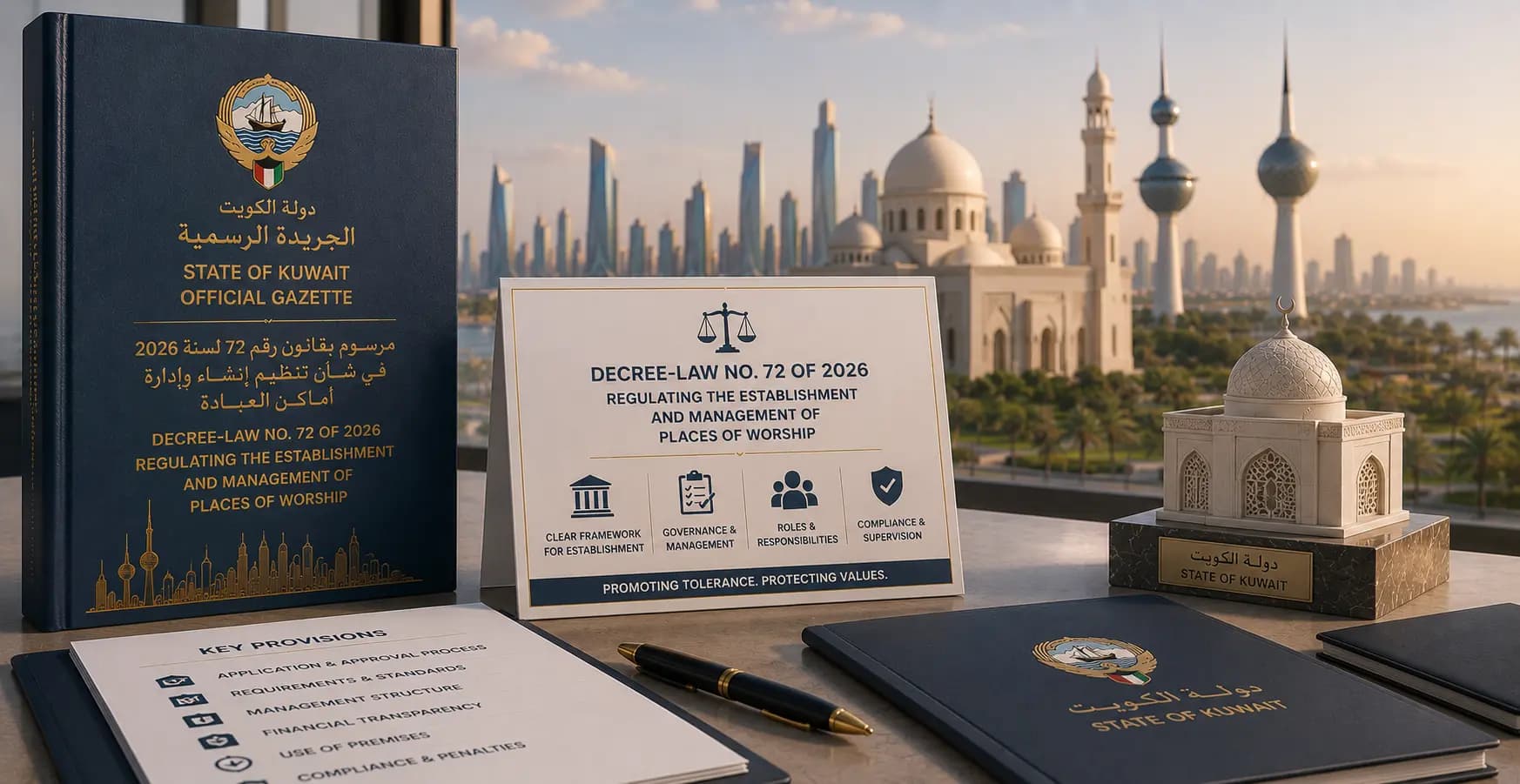
KDIPA Suspends Foreign Investor's Licence Over Kuwaitisation Breach; Four Firms Hit in Two Weeks
KDIPAKuwaitisationRegulatory EnforcementComplianceForeign Investment

KDIPA Suspends Foreign Investor's Licence Over Kuwaitisation Breach; Four Firms Hit in Two Weeks

The Kuwait Direct Investment Promotion Authority (KDIPA) has temporarily suspended the investment licence of a foreign power-sector investor for failing to meet the Kuwaiti-national workforce ratio attached to its licence — the latest in a wave of enforcement actions that has touched four foreign companies in roughly two weeks. The suspension was formalised by Ministerial Decision No. 207 of 2026, issued by the Minister of State for Economic Affairs and Investment in his capacity as Chairman of KDIPA, and published in the Official Gazette (Kuwait Al-Youm), Issue No. 1793, dated 31 May 2026, at page 76. The decision names the investment entity “Shanghai Engineering Company for Electric Power Transmission and Distribution Limited” (commercial licence 4728/2017; investment licence 24/2017-T1) and cites a breach of licence conditions for not employing the agreed number of national workers. The decision rests on follow-up and audit reports dated 23 December 2025 and 14 April 2026 and a KDIPA board resolution taken at its meeting No. 1/2026 on 16 April 2026. The entity has been ordered to submit proof that the violation has been remedied no later than 7 July 2026; failing which it becomes exposed to the more severe penalty under Article 32 of the Direct Investment Promotion Law No. 116 of 2013. Local press (Times Kuwait, 1 June 2026) reported that KDIPA had, in the same short window, cancelled the licences of three further foreign companies following similar compliance reviews — signalling a clear shift from incentive-led promotion toward active, audit-driven oversight that links investment privileges to measurable national-economy contribution, including Kuwaitisation and knowledge transfer. For foreign investors operating under a KDIPA licence, the message is direct: the national-workforce undertakings given at licensing are now being tested against audit evidence, and remediation windows are short. Affected entities should treat a suspension notice as a time-critical matter requiring an immediate compliance and representation strategy. Sources: Kuwait Al-Youm, Issue 1793, 31 May 2026, p.76 (Ministerial Decision No. 207/2026); Times Kuwait, “KDIPA suspends, delists four foreign companies within two weeks”, 1 June 2026.

Learn more

Kuwait's Supreme Petroleum Council Approves KIPIC–KNPC Merger by Absorption
Oil & GasMergers & AcquisitionsEnergyCorporate Restructuring

Kuwait's Supreme Petroleum Council Approves KIPIC–KNPC Merger by Absorption

Kuwait City — Kuwait's Supreme Petroleum Council (SPC) has approved the merger of Kuwait Integrated Petroleum Industries Company (KIPIC) into Kuwait National Petroleum Company (KNPC), consolidating two downstream subsidiaries of Kuwait Petroleum Corporation (KPC) into a single national refiner. The decision was taken at SPC Meeting No. 132 (2026/4) on 29 April 2026 and published in the official gazette, Kuwait Al-Youm, at the end of May 2026. Under it, KIPIC ceases to exist as a separate legal entity and KNPC succeeds to all of KIPIC's assets, rights, obligations and liabilities by way of universal succession — a merger by absorption. To give effect to the merger, the SPC approved an increase in KNPC's capital equal to the book value of KIPIC's assets as at 31 March 2026, lifting KNPC's capital to approximately KD 2.63 billion (about US$8.5 billion). The plan provides for compensation of KIPIC's minority shareholders — other than KPC — based on an approved asset valuation, and for amendments to KNPC's articles of association to absorb KIPIC's refining, petrochemicals and LNG-import operations at Al-Zour. The Minister of Oil, in his capacity as KPC chairman, is authorized to set the effective date and oversee implementation, including the final termination of KIPIC's legal status. The consolidation is the most significant restructuring of Kuwait's downstream petroleum sector in years. It carries direct consequences for KIPIC's contractors, suppliers and counterparties, whose agreements, guarantees and disputes transfer to KNPC by operation of the merger. ► Source: Supreme Petroleum Council Decision, Meeting No. 132 (2026/4), 29 April 2026; published in Kuwait Al-Youm (late May 2026). Cross-referenced with Reuters/Zawya, Kuwait Times and AGBI reporting, June 2026. [Confirm exact gazette issue & page against the relevant Kuwait Al-Youm issue before citing in print.]

Learn more

Kuwait Competition Authority Publishes Merger Notice in Foxconn–Mitsubishi Fuso Bus Deal; 15-Day Objection Window Opens
Competition LawMerger ControlCPAMergers & AcquisitionsCross-border Transactions

Kuwait Competition Authority Publishes Merger Notice in Foxconn–Mitsubishi Fuso Bus Deal; 15-Day Objection Window Opens

Kuwait City — The Kuwait Competition Protection Authority (CPA) has published a notice of an economic concentration in the Official Gazette “Kuwait Al-Youm,” Issue No. 1793 (page 180), dated 31 May 2026, inviting any interested party to submit a reasoned objection within fifteen (15) days of publication. According to the notice, Lin Yin International Investments Ltd (Taiwan) — a company wholly owned by Hon Hai Precision Industry Ltd (Foxconn) — has applied for clearance to acquire 50% of the shares of Mitsubishi Fuso Bus Manufacturing Ltd (Japan), currently held by Mitsubishi Fuso Truck and Bus Corporation. The filing is made under Law No. 72 of 2020 on the Protection of Competition and Article 83 of its Executive Regulations issued by Resolution No. 14 of 2021 (as amended). The transaction forms part of a wider global arrangement announced in January 2026, under which Foxconn and Mitsubishi Fuso plan to establish a new Japan-based zero-emission bus manufacturer. Its appearance in Kuwait’s Gazette confirms that the parties’ activities meet the local notification thresholds — a reminder that Kuwait’s merger-control regime reaches global transactions with a Kuwaiti nexus. Under Article 83, “any interested party may submit a reasoned objection to the economic-concentration application within fifteen days from the date of notification or publication.” Objections are filed at the CPA’s headquarters, Al-Hamra Tower, 14th floor, using the form available on the Authority’s website and on payment of the prescribed fee. The notice lands shortly after the CPA raised its merger-control thresholds by Resolution No. 32 of 2026 (effective 5 April 2026), lifting the single-party Kuwait turnover threshold to KD 1.5 million. Businesses with sales or assets in Kuwait that are party to cross-border deals should assess, early in any transaction, whether a Kuwaiti filing is triggered — the law requires application within 60 days of the relevant agreement. Source: Kuwait Al-Youm, Issue 1793, page 180 (Competition Protection Authority notice), 31 May 2026.

Learn more

Comprehensive Overview of Kuwait's New Residency Law for Foreigners (Decree No. 114/2024)
Residency LawForeign ResidencyInvestor ResidencyProperty OwnershipImmigration

Comprehensive Overview of Kuwait's New Residency Law for Foreigners (Decree No. 114/2024)

On November 28, 2024 , Kuwait’s Amir issued Decree No. 114/2024 , introducing a modernized Residency Law for Foreigners. The law, consisting of 36 articles across seven chapters , replaces the outdated legislation from 1959. It aims to address current challenges, regulate residency practices, and attract investment while ensuring national security. Key Provisions of the Residency Law: 1. Entry and Exit Requirements: Article 1: Foreigners must possess a valid passport or equivalent travel document issued by their country of origin to enter or exit Kuwait. Citizens of GCC countries may enter with personal ID cards. Article 2: The Ministry of Interior determines the types of entry visas and the procedures for obtaining them. Article 3: Citizens of certain countries may be exempt from entry visas based on reciprocity agreements. Article 4: Entry and exit must occur through designated ports, following procedures set by the Ministry. Article 5: Transport operators, such as airline captains and shipmasters, must provide passenger lists and report any unauthorized passengers to the authorities. 2. Notification Requirements: Article 6: Births within Kuwait must be reported to authorities within four months. Newborns must obtain residency permits or leave the country. Article 7: Foreigners must report lost or damaged passports within two weeks. Article 8: Hotels and furnished apartments must inform authorities about foreign guests within 48 hours of their arrival or departure. 3. Residency Permits: Article 9: Foreigners intending to reside in Kuwait must obtain a residency permit from the Ministry of Interior. Article 10: Kuwaiti women can sponsor their non-Kuwaiti husbands and children for residency, provided they did not acquire Kuwaiti citizenship through marriage. Article 11: Visitors are allowed to stay for a maximum of three months under a visit visa, extendable only through a residency permit. Article 12: Temporary residency permits, lasting up to three months and renewable for one year, are available under specific conditions. Article 13: Regular residency permits are capped at five years. However: Children of Kuwaiti Women are eligible for permits up to 10 years. Property Owners can receive permits of up to 10 years. Investors are eligible for permits of up to 15 years. Importantly, Article 13 introduces residency rights for property owners, signaling a potential shift in Kuwait's policies. Although foreigners are currently prohibited from owning property in Kuwait, this provision suggests that reforms may be underway to allow foreign ownership in the future. Such a change would align with efforts to attract foreign investment and stimulate economic development. Article 14: Domestic workers receive residency permits matching their employment contracts. Upon contract termination, residency is canceled, requiring departure within a specified timeframe. Article 15: Government employees or private sector workers can obtain residency permits upon employer request. Article 16: Sponsors must notify authorities if a foreigner overstays their visa or residency. Article 17: The Ministry of Interior sets fees for residency permits and entry visas. Children of Kuwaiti women are exempt from these fees. 4. Employment and Residency Compliance: Article 18: Residency trafficking, including exploiting foreigners for financial gain, is strictly prohibited. Article 19: Foreigners cannot work for employers other than their sponsors, and sponsors cannot misuse their permits for unauthorized purposes. 5. Deportation Rules: Article 20: The Ministry of Interior can deport foreigners lacking legitimate sources of income or violating the law, following a specified grace period. Article 21-26: Deportation rules allow foreigners time to complete tasks beneficial to the state and outline conditions for their potential return to Kuwait. 6. Penalties for Violations: Article 27-28: Violators face penalties including imprisonment, fines, or both for breaches of the residency law. Repeat offenders and public officials involved in residency trafficking may receive harsher punishments. 7. Exemptions and Special Provisions: Heads of state, diplomats, and their families are exempt from this law. The Ministry of Interior retains the authority to issue regulations and exceptions as needed. Special Residency Provisions for Investors and Property Owners Investors: Eligible for long-term residency permits of up to 15 years, fostering a favorable investment climate. Property Owners: Entitled to permits lasting up to 10 years, respecting constitutional rights to private property ownership. Key Highlights for Foreigners: This law emphasizes transparency, fairness, and security, aiming to balance Kuwait’s national interests with the needs of its foreign residents and investors. The Ministry of Interior is responsible for issuing detailed regulations to facilitate the law's implementation within the next six months. This comprehensive overhaul is expected to have far-reaching impacts on expatriates, sponsors, and businesses in Kuwait. Compliance with the new residency rules is essential to avoid legal repercussions.


Learn more