

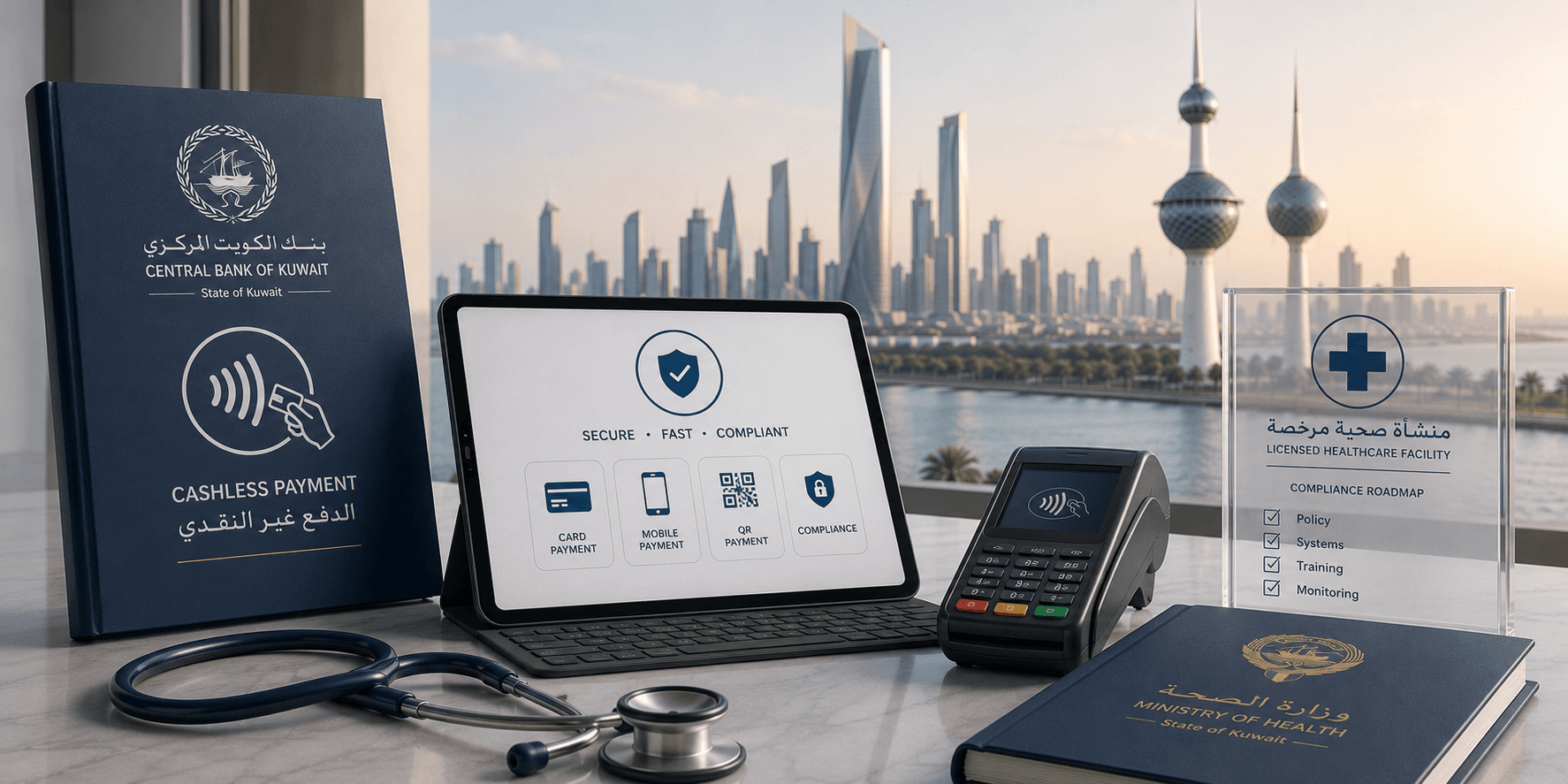
Kuwait's Cashless Mandate Reaches Private Healthcare: A Compliance Roadmap for Licensed Facilities
19-07-2026
MOCICashless PaymentsAML ComplianceRegulatory Enforcement
Ministerial Decision No. 110 of 2026, issued by the Minister of Commerce and Industry on 12 July 2026 and published in the Official Gazette (Kuwait Al-Youm, Issue 1800, page 13) on 19 July 2026, prohibits every company owning a Ministry of Health-licensed private health facility from taking cash exceeding KD 10 when collecting service fees. Payments above that figure must move through banking channels and electronic payment services approved by the Central Bank of Kuwait. A facility that breaches the rule is to be closed and referred to the competent investigation authorities.
Why this matters
Most regulatory change in Kuwait gives operators a runway. This one does not. The decision takes effect from its date of issue rather than gazette publication, which means licensed hospitals, medical centres, clinics and home healthcare providers have been in scope since 12 July 2026 — a week before the text reached the gazette. There is no transitional period, no grace window for existing contracts, and no de minimis carve-out beyond the KD 10 line itself. At that level the threshold does not moderate cash use; it removes it. A single consultation fee, a prescription dispensed at a clinic pharmacy counter, a physiotherapy session — all sit above KD 10 in ordinary practice.
What the decision actually requires
Article One is drafted around the licence holder rather than the premises. The obligation falls on 'companies owning private health facilities licensed by the Ministry of Health', and the enumeration — hospitals, medical centres, clinics, home healthcare providers 'and other licensed private medical establishments' — is expressly non-exhaustive. Group structures should therefore map the obligation to each licence-holding entity, not to each building. Where a management company operates a facility licensed to a separate SPV, both the operational reality and the licensing chain need to be checked against the wording.
The permitted alternative is narrower than 'non-cash'. Article One requires payment through the banking channels and electronic payment services 'approved by the Central Bank of Kuwait', with compliance with the Bank's regulating instructions. Informal transfer arrangements, unlicensed wallet products or settlement through a third-party intermediary that is not within the CBK-approved perimeter will not discharge the obligation merely because no banknotes changed hands.
The sanction is closure, not a fine
Article Two is where the commercial risk concentrates. It preserves any other measure or penalty available under related laws, applies the penalties in Decree-Law No. 10 of 1979 on the supervision of trade in goods, services and handicrafts, and then provides that a violating establishment 'shall be closed and referred to the competent investigation authorities'. Two features deserve attention. First, closure is expressed as a consequence rather than a discretion, which materially limits the room for negotiated remediation once a breach is recorded. Second, referral to the investigation authorities converts what looks like a payments-operations lapse into a matter with potential criminal exposure for the company and those responsible for its management. For a hospital group, a closure order of even a few days carries clinical, contractual and reputational consequences far exceeding any realistic fine.
A pattern, not a one-off
Decision 110/2026 is the second published instalment of the same policy. In April 2026 the ministry issued Ministerial Decision No. 32 of 2026, imposing an identical KD 10 ceiling — and the identical closure-and-referral sanction — on health institutes, men's, women's and children's salons, sports clubs, pest control companies, and businesses importing, exporting or storing public health pesticides. The two decisions share a drafting template: a single operative prohibition, a cross-reference to Decree-Law No. 10 of 1979, a repeal clause, and immediate effect. The recitals to Decision 110 place the policy in its proper frame by citing Law No. 106 of 2013 on combating money laundering and the financing of terrorism alongside the Companies Law, the Commercial Shop Licences Law as amended by Decree-Law No. 162 of 2025, and the Consumer Protection Law. Read together, the direction of travel is clear: cash-intensive licensed activities are being brought inside the traceable payments perimeter sector by sector.
What in-scope facilities should do now
Five steps are immediate. Confirm which entity in the group holds each Ministry of Health licence and attach the obligation there. Audit every collection point — reception, pharmacy counter, laboratory, radiology, home-visit teams collecting at the patient's door — because mobile and home healthcare collection is the most commonly overlooked channel and is expressly named in Article One. Verify that each payment instrument in use sits within the CBK-approved perimeter and that the supporting merchant contracts are current. Issue written front-desk instructions and a refusal script, so that staff decline over-threshold cash consistently rather than exercising discretion. Finally, build a retrievable audit trail: the practical defence to an allegation of breach is contemporaneous transaction records showing that over-threshold collections were routed electronically.
Operators should also revisit patient-facing terms and any insurer or corporate-account arrangements that contemplate cash settlement, and consider the accessibility question that follows from a hard electronic-only rule — particularly for unbanked patients and for emergency presentations, where a documented escalation procedure is preferable to improvised exceptions.
WEFAQ's view
The realistic compliance risk here is not deliberate evasion; it is an isolated over-threshold cash receipt taken by a junior staff member at a peripheral collection point, at a facility whose management believed it was compliant because its main reception had been converted. Given that the stated consequence is closure and referral rather than a proportionate fine, the sensible posture is conservative: treat the KD 10 line as an absolute internal prohibition on cash receipts of any size wherever operationally feasible, and document the change. Groups in the activities already captured by Decision 32/2026 should assume their remaining lines of business will follow, and would be better served by a single group-wide payments policy now than by another retrofit when the next decision issues.
• • •
Source: Kuwait Al-Youm, Issue 1800, page 13 (Ministry of Commerce and Industry, Ministerial Decision No. 110 of 2026 on the prohibition of cash transactions by companies in certain activities), dated 19 July 2026; Ministerial Decision No. 32 of 2026; Decree-Law No. 10 of 1979; Law No. 106 of 2013; KUNA, 7 April 2026.
This article is provided for general information only and does not constitute legal advice. For advice specific to your circumstances, please contact WEFAQ Law Firm.
Related articles


Kuwait's New Arbitration Law 2026: What Changes for Contracts, Disputes and Government Dealings
Learn more
Kuwait's New Housing Finance Law 2026: What It Means for Families, Banks and Developers
Learn more
Tower Sharing With Conditions: What the Zain and Ooredoo Clearance Means for Kuwaiti Telecom Deals
Learn more
Kuwait Media Law 2026: What It Means for Influencers, Companies and Media Businesses
Learn more