

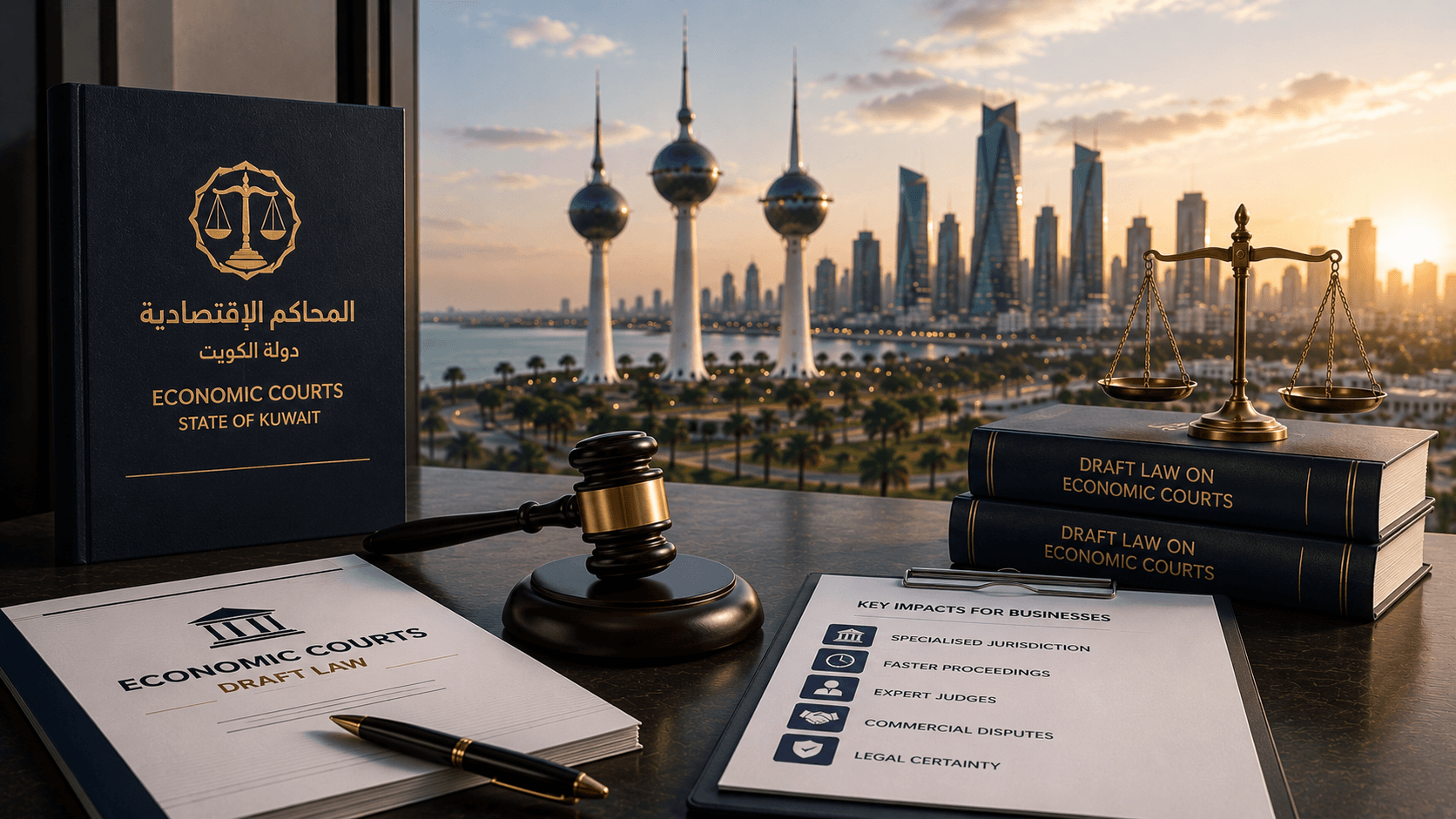
Kuwait's New Economic Courts: What the Draft Law Means for Your Business
20-08-2026
Economic CourtsDispute ResolutionEnforcementE-Litigation
The Council of Ministers approved a draft decree-law issuing the Law Establishing Economic Circuits on 18 August 2026, and the Minister of Justice, Counsellor Nasser Al-Sumait, set out its main features to KUNA the following day. WEFAQ has reviewed the full 32-article draft prepared by the Fatwa and Legislation Department. Under the draft, the new system starts on 1 October 2027.
Why this matters: Kuwait is building a dedicated court track for business disputes. If your company banks, invests, contracts with the government, or holds shares in a Kuwaiti company, there is a good chance your next significant dispute will be heard by an economic circuit, under faster procedures, through an electronic platform, and only after a mandatory settlement attempt. Knowing the rules now means you can prepare contracts and dispute strategies before the courts open.
A specialised court at every level
The draft creates economic circuits at all three tiers. At the Court of First Instance, each circuit sits with three judges, and its judgment is final where the claim does not exceed KWD 10,000. Separate circuits handle civil and commercial disputes on one side and administrative economic disputes on the other. A single delegated judge deals with urgent matters, orders on petitions and performance orders. At the Court of Appeal, economic appellate circuits of three counsellors hear appeals, with finality where the claim does not exceed KWD 30,000. A dedicated economic circuit at the Court of Cassation takes challenges in larger or unvalued claims and in defined cases such as lack of jurisdiction or conflict with a prior final judgment. Judges assigned to these circuits must have suitable experience in economic disputes or receive specialised training through the Kuwait Institute for Judicial and Legal Studies.
Which disputes go there
Article 11 gives the economic circuits exclusive jurisdiction over seventeen categories of dispute. The commercially significant ones include: disputes under the Central Bank Law (Law No. 32 of 1968) and the Capital Markets Law (Law No. 7 of 2010); claims between clients and banks or licensed financial institutions above KWD 100,000; disputes between shareholders or partners, or over dissolution, liquidation and management accountability, covering joint stock companies of any capital, other commercial companies with capital above KWD 100,000, and KDIPA-licensed companies of any capital; disputes over non-Kuwaiti capital investment; oil contracting contracts performed in Kuwait; PPP projects under Law No. 116 of 2014; contract disputes arising from public tenders under Law No. 49 of 2016 above KWD 100,000; competition cases under Law No. 72 of 2020; patents, industrial designs and GCC trademarks; other administrative contracts above KWD 100,000; and requests to enforce foreign judgments and arbitral awards whose subject matter would fall within the circuits' jurisdiction. Employment and staff disputes are expressly excluded.
Settlement first, litigation second
The draft makes settlement a mandatory first stop. A settlement office attached to the technical office, chaired by a delegated judge, receives every substantive case on filing and must attempt settlement within fifteen days, extendable by agreement up to three months in total. Urgent cases, orders on petitions, performance orders and provisional measures are exempt. If settlement succeeds, the minutes signed by the parties and approved by the head of the office carry the force of an executory instrument; the dispute ends without ever reaching a courtroom. Settlement negotiations are confidential and cannot be used against a party later, and time spent in settlement does not count toward prescription periods.
Digital litigation, start to finish
Every step runs through an electronic platform: filing, exchange of memoranda, hearings where remote technology is permitted, judgments, and enforcement. A case preparation office checks that filings are complete before a hearing is set; a defendant has fifteen days from service to file its defence, and a hearing must then be set within three days. Late submissions are barred unless the circuit accepts a valid excuse. The platform will also host an anonymised database of final judgments and judicial principles, a first for Kuwaiti court transparency in commercial matters.
Enforcement with real teeth
A specialised enforcement department, staffed by judges and supported by experts in accounting, securities and asset valuation, handles execution. The enforcement judge may attach assets, freeze bank accounts, impose travel bans on debtors where there is serious evidence of asset flight, and take any protective measure the law allows. These orders can issue urgently without prior notice to the debtor, who then has ten days to object. Article 27 creates a direct electronic link with banks and registries so attachment, transfer of ownership and asset sales happen without paper correspondence, and Article 32 moves judicial sales to electronic auctions announced on the platform and in the Official Gazette.
What businesses should do before October 2027
First, revisit dispute resolution clauses in Kuwaiti contracts: jurisdiction wording, escalation steps and settlement mechanics should anticipate the mandatory settlement stage. Second, map which of your existing and likely disputes fall within Article 11, particularly the KWD 100,000 thresholds for banking, tender and administrative contract claims. Third, get document-ready: the case preparation office will not register a claim without supporting documents, so contract files, correspondence and financial records need to be retrievable quickly. Fourth, watch for the executive regulations, which will set the fees, platform rules and settlement procedures. Cases pending before the Capital Markets Court and current circuits stay where they are, so there is no need to rush or delay existing litigation on account of the new law.
WEFAQ's view: the draft reflects a serious effort to give Kuwait a commercial court system comparable to those in neighbouring financial centres. The mandatory settlement stage and the electronic enforcement link are the two provisions most likely to change day-to-day practice. WEFAQ advises clients with significant Kuwaiti exposure to begin aligning contracts and dispute planning with the new framework now, rather than after the regulations issue.
• • •
Source: Draft Decree-Law issuing the Law Establishing Economic Circuits, Council of Ministers Fatwa and Legislation Department, 2026; Minister of Justice statement to KUNA, 20 August 2026.
This article is provided for general information only and does not constitute legal advice. For advice specific to your circumstances, please contact WEFAQ Law Firm.
Related articles


Kuwait Media Law 2026: What It Means for Influencers, Companies and Media Businesses
Learn more
UPDATE: What Kuwait's Amended Public Tenders Law Means for Contractors and Suppliers
Learn more
The Capital Markets Court Is Being Retired: What Decree-Law 91/2026 Means for Issuers, Brokers and Investors
Learn more
UPDATE: How Kuwait's Government Sukuk Programme Will Work
Learn more