

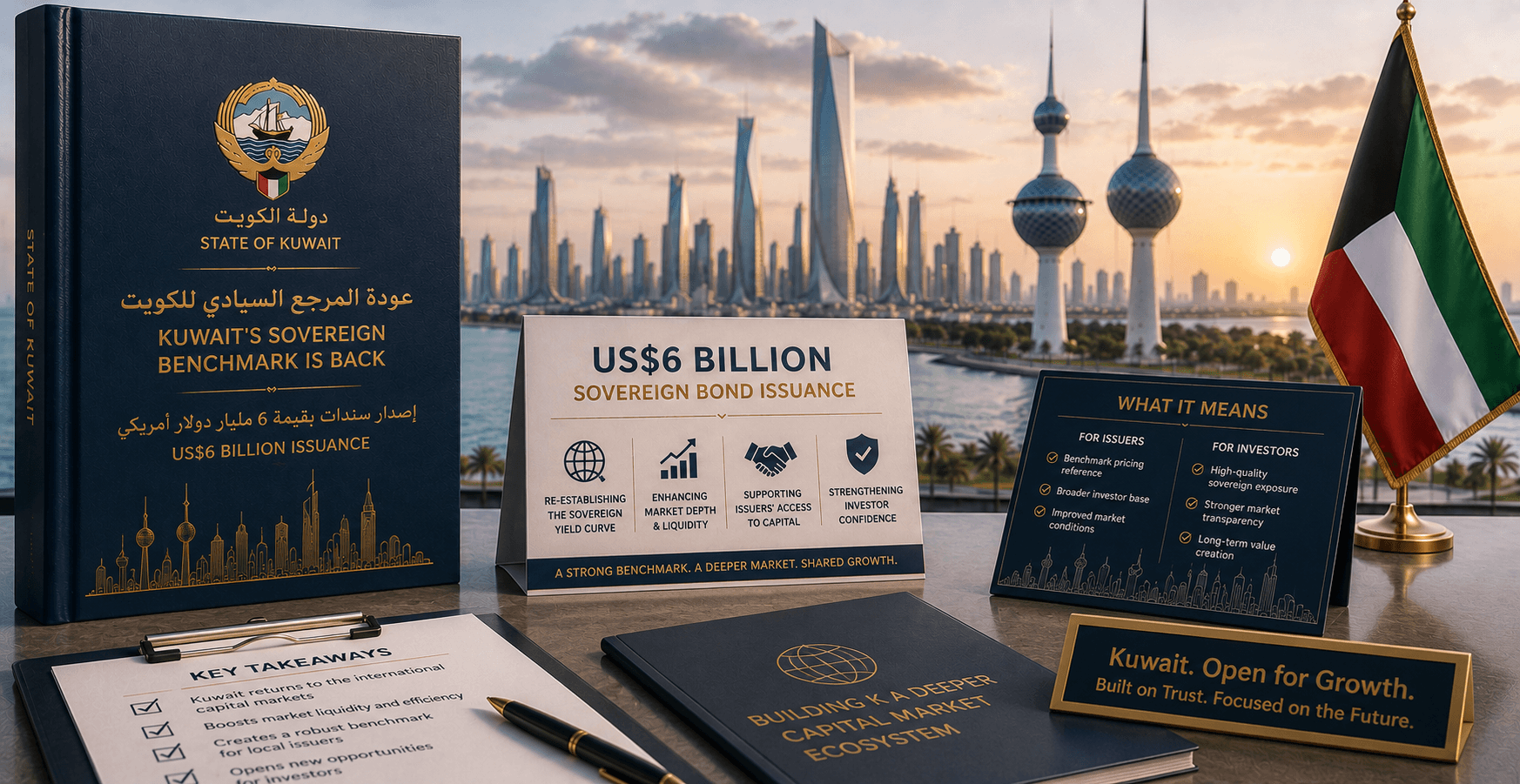
Kuwait's Sovereign Benchmark Is Back: What the US$6 Billion Issuance Means for Issuers and Investors
24-07-2026
Sovereign BondsDebt Capital MarketsBoursa KuwaitFinancing & Liquidity Law
On 23 July 2026 the Ministry of Finance completed the State of Kuwait's US$6 billion three-tranche sovereign bond issuance: US$3 billion of three-year notes at 70 basis points over US Treasuries, US$1.5 billion of five-year notes at 75 basis points, and US$1.5 billion of ten-year notes at 85 basis points. The order book exceeded US$18 billion, more than three times the offered amount, and final pricing came roughly 25 basis points inside initial guidance, according to market commentary reported by Al-Rai. Allocations reached investors across the Americas (approximately 48 per cent), the United Kingdom and Europe (28 per cent), the Middle East and North Africa (16 per cent) and Asia (4 per cent).
Why this matters: a sovereign issuance is more than a financing exercise. It restores the pricing benchmark against which every Kuwaiti bank and corporate will measure its own US-dollar funding, it gives international institutions a liquid entry point into Kuwaiti credit, and it is the first benchmark-scale test of the legal architecture Kuwait has assembled since early 2025. That the demand arrived despite heightened regional security conditions — a point emphasised by the economists quoted in the local press — makes the signal harder to dismiss.
The legal architecture, now fully deployed
The issuance rests on Decree-Law No. 60 of 2025 concerning Financing and Liquidity, in force since 27 March 2025. The law ended an eight-year legislative vacuum that had kept Kuwait out of the international debt markets, established a public borrowing ceiling of KD 30 billion, and authorised sovereign instruments — bonds and sukuk alike — with maturities of up to fifty years. On the market-infrastructure side, the Capital Markets Authority's approval of the bonds and sukuk framework earlier this year and the operational launch of Boursa Kuwait's dedicated listing and trading platform, which WEFAQ covered in June, mean that primary issuance and secondary trading now sit within a single, coherent regulatory perimeter. This transaction is the first to exercise that perimeter at benchmark scale.
A reference curve for the private sector
Pricing points at three, five and ten years give Kuwaiti issuers something they have lacked for years: a current, market-tested sovereign curve from which corporate and bank credit spreads can be derived. Treasury teams weighing a US-dollar bond or sukuk can now approach rating agencies and arrangers with a live benchmark rather than a stale or interpolated one. Banks in particular should find their own wholesale funding conversations simplified, and issuers that shelved plans during the years without a sovereign reference now have an objective basis on which to revisit them.
Reading the order book
Three features of the demand stand out. First, scale: an order book above US$18 billion for a US$6 billion offer ranks among the larger multi-tranche sovereign books of 2026. Second, composition: nearly half the allocation went to investors in the Americas, with meaningful European and regional participation — a distribution that suggests durable institutional appetite rather than opportunistic regional buying. Third, pricing tension: tightening of around 25 basis points from initial guidance indicates that demand held through the pricing process. Commentators quoted by Al-Rai attributed the outcome to Kuwait's exceptional sovereign asset base and payment capacity, noting that the issuance succeeded even amid the temporary disruption to crude oil exports.
What issuers should do now
Kuwaiti banks and corporates considering the debt markets should treat the sovereign transaction as the starting gun. Practical preparation includes assessing whether a standalone issuance or a programme better fits funding needs; reviewing disclosure and prospectus obligations under the Capital Markets Authority framework; deciding on listing venue and governing law for the documentation; and preparing the credit story early, since windows in the current environment may open and close quickly. Engaging counsel and arrangers before a window opens, rather than after, is what separates issuers who print from issuers who watch.
What investors should watch
The KD 30 billion ceiling leaves substantial headroom, and official commentary has consistently framed the strategy as diversifying funding sources — which points to further issuance, potentially including a sukuk tranche given the instruments expressly contemplated by Decree-Law No. 60 of 2025. Secondary liquidity on Boursa Kuwait's bonds and sukuk platform will be worth monitoring as listed instruments accumulate, as will the emergence of a Kuwaiti dinar yield curve alongside the US-dollar one.
WEFAQ advises issuers on debt capital markets documentation, CMA disclosure and listing requirements, and cross-border offering structures, and advises institutional investors on access to Kuwaiti debt instruments. The firm's Capital Markets & Finance team is available to discuss issuance readiness in the current window.
This article is provided for general information only and does not constitute legal advice. For advice specific to your circumstances, please contact WEFAQ Law Firm.
Related articles


Kuwait's New Arbitration Law 2026: What Changes for Contracts, Disputes and Government Dealings
Learn more
Kuwait's New Housing Finance Law 2026: What It Means for Families, Banks and Developers
Learn more
Tower Sharing With Conditions: What the Zain and Ooredoo Clearance Means for Kuwaiti Telecom Deals
Learn more
Kuwait Media Law 2026: What It Means for Influencers, Companies and Media Businesses
Learn more