

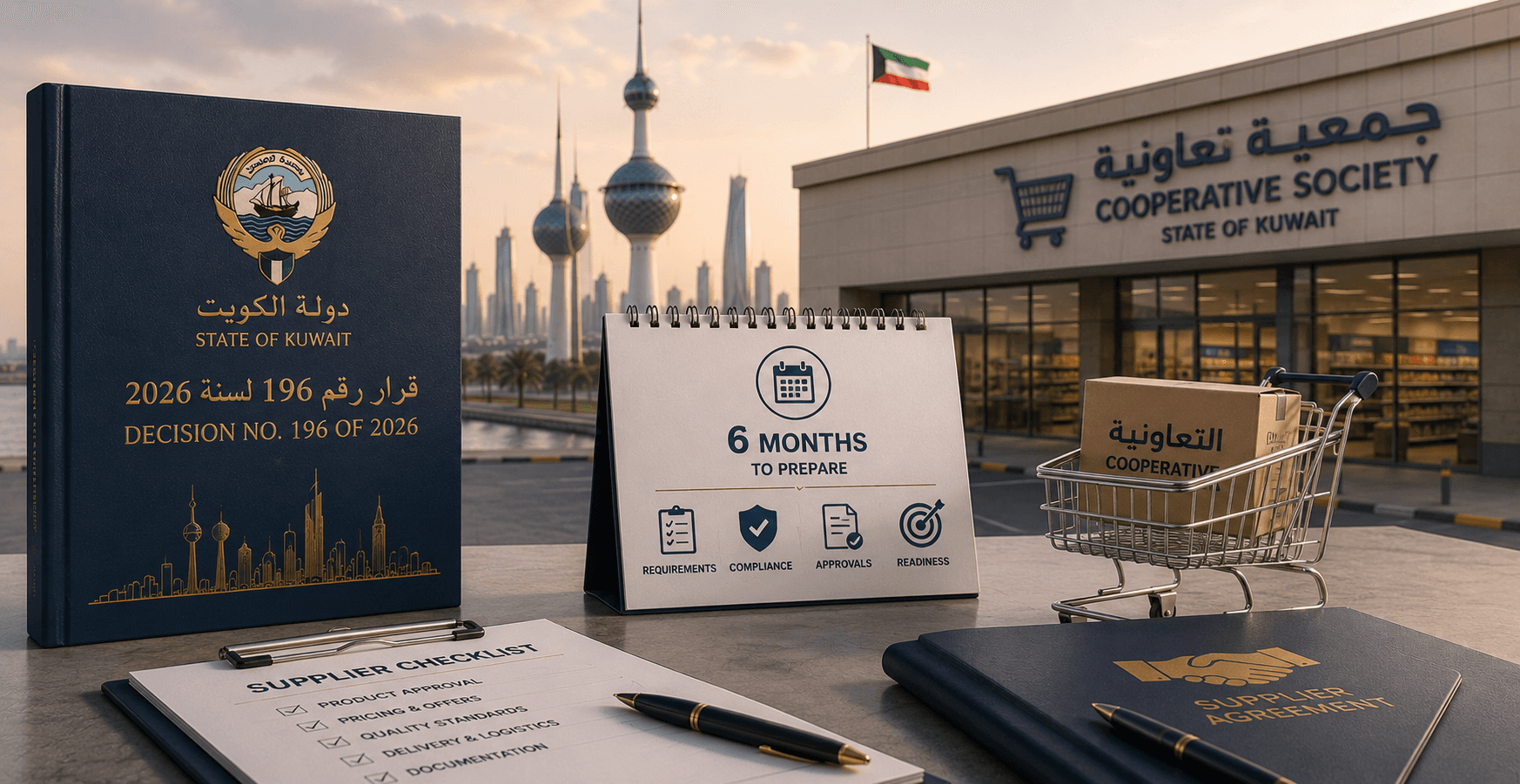
Selling Into Kuwait's Cooperatives: What Decision 196 of 2026 Changes for Suppliers, and the Six-Month Window to Prepare
20-07-2026
Cooperative SocietiesSupplier Payment TermsRetail Supply ContractsTrade Terms
Ministerial Decision No. 196 of 2026, published in the Official Gazette on 19 July 2026 (Kuwait Al-Youm, Issue 1800, pages 16–34), promulgates a new Regulation on the Organisation of Cooperative Work in place of Ministerial Decision No. 46/T of 2021 and related instruments. It fixes statutory payment periods for cooperative suppliers, makes payment compliance a monitored regulatory metric, and prohibits societies from conditioning shelf space on promotional contributions.
Why this matters
Kuwait's consumer cooperative societies are not a marginal channel. They are the backbone of grocery retail, and for many food, household and consumer-goods suppliers they represent the single largest domestic route to market. Until now the commercial terms of that relationship — when invoices are paid, what a supplier must contribute to get listed, what happens to slow-moving stock — were largely a matter of negotiation, and negotiating leverage sat with the society. The Regulation converts several of those points into regulatory obligations enforced by the Ministry rather than by the supplier's contract.
Payment terms become a rule, not a negotiation
Article 55 requires a society to settle supplier dues within 15 days of the end of the supply month for fast-moving goods and national products, and within 45 days for all other goods, determined by reference to the electronic clearance and point-of-sale records. Article 56 allows earlier payment only as an exception and only on defined terms: the supplier must agree under its supply contract, the discount is banded to average stock turnover — 1% where average turnover is under one month, 2% from one month to under two, 3% from two to three months — accelerated payments are disbursed within ten days of the month's end, the society retains a reserve of 20% of goods value against the electronic clearance, and the facility is confined to suppliers with at least three years of continuous dealing who request it and accept responsibility for the value of stagnant goods.
Article 57 is the enforcement hook. Societies must record, through an automated system, each supplier's due date, the actual payment date and any reason for delay, and the rate of compliance with payment periods becomes a periodic supervisory indicator tracked by the Ministry. A supplier's remedy for late payment is therefore no longer purely contractual; persistent late payment becomes visible to the regulator as a performance measure of the society itself.
An end to pay-to-list
Article 65 prohibits a society from obliging a supplier to take part in festivals or promotional offers, or to provide discounts or financial or in-kind benefits, as a condition of accepting supply, continuing to display the product, or renewing the trading relationship. Participation must rest on a written request or a documented approval from the supplier. Read with Article 61, which bars a society from using one supplier's free goods to fund price reductions on another's products, and Article 64, which confines marketing festivals to Ministry-approved events with a funded allocation and no draws, prizes or free coupons, the effect is a fairly direct attack on the informal trade-terms economy that tends to grow up around shelf allocation.
Tighter admission, and more paperwork
Access to the channel is also formalised. Article 52 places registration and approval of suppliers and items with the Union of Consumer Cooperative Societies, requires it to act quickly and transparently, and expressly bars it from conditioning registration, amendment or renewal on requirements of a commercial character unconnected to product safety, documentation or regulatory conformity; the registration certificate carries a QR code giving digital access to the underlying documents. Article 53 then sets the registration conditions themselves: for imported items these run to MOCI-approved commercial agent status, exclusive cooperative-channel distribution under a contract approved and certified by the Ministry of Commerce and Industry, ownership of a registered trademark, and a certificate of origin with customs data; parallel conditions apply to items produced, manufactured or packed locally, resting on ownership of a licensed factory or facility or an equivalent certified exclusive-distribution contract.
Article 54 prohibits dealing with any supplier without a concluded contract on the Ministry's standard form, and Article 62 elevates the supplier account statement to an official document before both the Ministry and the society, with the supplier bearing legal consequences for concealing goods or support. Articles 58 and 59 tie payment to stock hygiene: slow-moving goods in central markets whose turnover exceeds 90 days must be returned, and dues are not settled until such goods are disposed of or returned and damaged goods removed from actual balances.
The commencement trap
The Regulation is published but not yet operative, and the distinction matters. Article 121 requires the Ministry's unified electronic platform to be established and operational within six months of publication, and Article 120 gives the same six months for updating the unified cooperative accounting system to international accounting standards, issuing four guides and preparing the standard-form contracts. Article 122 then provides that, without prejudice to those transitional articles, the Regulation enters into force only after the platform is running, that the rules in force at publication continue to apply meanwhile, and that a later ministerial decision will fix the commencement date.
WEFAQ's view
Suppliers should treat the six-month runway as preparation time rather than grace. Three steps are worthwhile now. First, map existing cooperative arrangements against Articles 53 and 54 — agency status, exclusivity documentation, trademark registration and certificates of origin — because these are admission conditions, and a gap discovered after commencement is a gap that stops supply. Second, review rebate, listing and promotional arrangements against Article 65; terms that operate as a condition of shelf space will need to be restructured as documented, supplier-initiated participation. Third, model the cash-flow effect: 15- and 45-day terms may improve working capital against current practice, but the Article 56 discount bands and the 20% reserve change the economics of early settlement, and the return obligation for stock turning slower than 90 days shifts inventory risk back up the chain. Suppliers who reach commencement with contracts already aligned to the standard form will negotiate from a materially better position.
• • •
Source: Kuwait Al-Youm, Issue 1800, pages 16–34 (Ministry of Social Affairs, Family and Childhood Affairs, Ministerial Decision No. 196 of 2026 issuing the Regulation on the Organisation of Cooperative Work), Articles 52–66 and 119–122, dated 19 July 2026; Decree-Law No. 24 of 1979 on Cooperative Societies as amended by Law No. 118 of 2013; Ministerial Decision No. 46/T of 2021 (repealed).
This article is provided for general information only and does not constitute legal advice. For advice specific to your circumstances, please contact WEFAQ Law Firm.
Related articles


Kuwait's New Arbitration Law 2026: What Changes for Contracts, Disputes and Government Dealings
Learn more
Kuwait's New Housing Finance Law 2026: What It Means for Families, Banks and Developers
Learn more
Tower Sharing With Conditions: What the Zain and Ooredoo Clearance Means for Kuwaiti Telecom Deals
Learn more
Kuwait Media Law 2026: What It Means for Influencers, Companies and Media Businesses
Learn more