


Setting Up in Kuwait Through KDIPA: Investment Licence, Branch or Representative Office?
12-11-2026
KDIPA100% Foreign OwnershipCompany FormationForeign Investment
Foreign investors who want to set up in Kuwait through the Kuwait Direct Investment Promotion Authority (KDIPA) can choose one of three forms under Law No. 116 of 2013 on the Promotion of Direct Investment and its Executive Regulations: a Kuwaiti company that can be up to 100% foreign-owned, a branch of the foreign company, or a representative office limited to market research (Article 8 of the Executive Regulations). The right choice depends on what you want to do in Kuwait: trade and hire, bid for contracts, or first study the market.
Why this matters: the form you pick at the start shapes almost everything that follows, from who carries the liabilities to whether you can bid for government work without a local agent. Changing course later costs time and money. This guide compares the three KDIPA routes in plain terms, explains what KDIPA asks for, and sets out what happens after approval.
In this article: 1. The three routes at a glance; 2. A Kuwaiti company with up to 100% foreign ownership; 3. A branch of a foreign company; 4. A representative office; 5. Incentives and what they depend on; 6. What KDIPA will not license; 7. The process, step by step; 8. How WEFAQ can help; 9. Frequently asked questions.
1. The three routes at a glance
Article 8 of the Executive Regulations (Ministerial Decision No. 502 of 2014) lists the three forms. The first is a Kuwaiti company set up for direct investment, in which the foreign investor may hold 100% of the capital of a shareholding company, a limited liability company or a single-person company. The second is a branch of a foreign company licensed to operate in Kuwait. The third is a representative office whose only purpose is to prepare market studies and look at production possibilities, without any commercial activity or commercial agency.
In short: a company is a separate Kuwaiti entity that can trade in its own name; a branch is the foreign parent itself, operating in Kuwait; a representative office cannot trade at all.
2. A Kuwaiti company with up to 100% foreign ownership
Who it suits: investors who plan to operate in Kuwait for the long term, employ staff, sign contracts in their own name and keep the Kuwaiti business legally separate from the parent. Normally a foreign investor needs a Kuwaiti partner to own a local company; a KDIPA licence is the route that allows full foreign ownership, using the company forms of the Companies Law (Law No. 1 of 2016).
A practical advantage: according to KDIPA's published guidance, a Kuwaiti company licensed by the Authority is treated as a Kuwaiti company and may take part in tenders without a Kuwaiti agent. For businesses that want to bid for public projects, that point alone often decides the question.
What KDIPA looks for (Article 14 of the Executive Regulations): an initial study covering the activity, the legal form, the size of the investment and how it will be financed, the expected economic and environmental impact, the investor's experience, and the project's needs for staff, land, raw materials, water and energy. KDIPA's document list also asks for the parent company's certified constitutional documents, an explicit and unconditional board approval to set up the Kuwaiti company under Law No. 116 of 2013, the appointment of the manager, and details of planned imports and of national and foreign staff.
3. A branch of a foreign company
Who it suits: established foreign groups that want to serve Kuwaiti clients directly, keep one legal entity, and are comfortable with the parent standing behind the Kuwaiti operation. A branch is not a separate company, and KDIPA requires the parent to undertake to meet the obligations arising from the branch's work.
Points to weigh: a branch needs the same initial study as a company, plus the parent's certified articles, latest audited financial statements and a certificate of existence (Article 15 of the Executive Regulations). KDIPA's guidance also states that a branch may take part in tenders only with a partner or a Kuwaiti agent under a notarised contract, which is a real difference from the company route.
4. A representative office
Who it suits: companies that want a presence in Kuwait to research the market before committing. The office may prepare market studies and look at production possibilities, but it may not trade or act as a commercial agent (Article 8 of the Executive Regulations).
The rules are set out in Ministerial Decision No. 393 of 2019. The parent must have been established for more than two years (Article 1). Registration is granted for up to one year and renewed annually, with reports on staff, the work carried out and the timetable of studies (Article 2). All papers and promotional material must state that it is a representative office of the parent (Article 3). Within three years of registration, the parent must show whether it has decided to set up a company or a branch in Kuwait, although the Director General may extend this (Article 5). A representative office is therefore a stepping stone, not a permanent base.
5. Incentives and what they depend on
Approved investments may apply for incentives, which are not automatic. KDIPA's published guidance and the Executive Regulations describe an exemption from income tax for up to ten years from the start of operations (Article 22), full or partial exemption from customs duties on machinery, spare parts, raw materials and packaging imported for the project (Articles 27 and 28), access to land and real estate allocated to or managed by KDIPA, and the recruitment of the foreign staff the project needs, within the applicable rules.
KDIPA weighs each application against criteria such as technology transfer, the quality of products, local market needs, economic diversification, exports, jobs and training for Kuwaitis, development of less developed areas, environmental impact, and the use of local products and local technical and consulting services. The more of these a project meets, and the better it documents them, the stronger the incentives case.
6. What KDIPA will not license
Direct investment is open to all activities except those excluded by Council of Ministers Decision No. 75 of 2015. According to KDIPA, the excluded list includes crude oil and natural gas extraction, certain fuel and fertiliser manufacturing, real estate activities (except privately operated building development projects), security and investigation services, public administration and defence, membership organisations, and labour hiring, including domestic labour. KDIPA also notes that the law sets no minimum investment value, and that it does not allow foreigners to own land or real estate in Kuwait, subject to limited exceptions for shareholding companies.
7. The process, step by step
Step one is choosing the route and the activity, which should match an activity recognised by the Ministry of Commerce and Industry. Step two is preparing the documents. Foreign documents must be legalised by the Kuwaiti embassy in the country of origin and by Kuwait's Ministry of Foreign Affairs, with an Arabic translation certified in Kuwait, so this stage often takes the longest. Step three is filing the application and the initial study with KDIPA.
Under Article 17 of the Executive Regulations, KDIPA decides on the application within thirty days once all conditions are met, and a rejection must be reasoned and in writing (Article 12). After approval, the entity is incorporated and its commercial licence issued. The investor must obtain the approvals needed to start work within one year of the licence unless its timetable allows longer, and must notify KDIPA of the actual start of operations within thirty days (Article 18). After that come the practical steps of running a business: registering with the Ministry of Commerce and Industry, work permits and labour compliance, commercial agency or distribution agreements, and trademark registration.
8. How WEFAQ can help
WEFAQ Law Firm is registered with KDIPA as an accredited firm that may file applications with the Authority on behalf of investors (KDIPA Director General Decision No. 429 of 2026, Kuwait Al-Youm Issue 1816, 8 November 2026). Our Foreign Direct Investment team helps investors choose between a company, a branch and a representative office, prepares the initial study and the document file, files the application and deals with KDIPA's questions, prepares the incentives request, and then handles incorporation, licensing, employment contracts, agency agreements and trademarks once the licence is granted.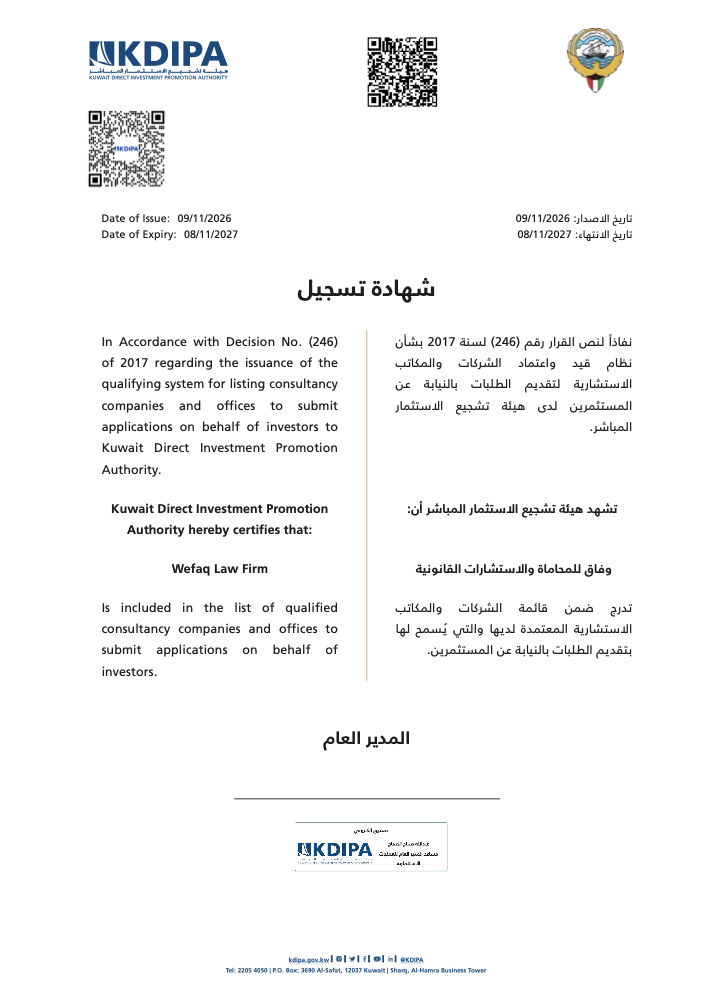
9. Frequently asked questions
Can a foreign company own 100% of a business in Kuwait?
Yes. Under Law No. 116 of 2013, a foreign investor licensed by KDIPA may own up to 100% of a Kuwaiti shareholding company, limited liability company or single-person company, provided the activity is not on the excluded list.
What is the difference between a KDIPA branch and a KDIPA company?
A company is a separate Kuwaiti entity; a branch is part of the foreign parent, which remains responsible for its obligations. KDIPA's guidance also treats them differently in tenders: a licensed company may bid without a Kuwaiti agent, while a branch needs a partner or a Kuwaiti agent.
Can a representative office sign contracts or sell in Kuwait?
No. A representative office may only prepare market studies and look at production possibilities. It may not carry out commercial activity or act as a commercial agent.
How long does KDIPA take to decide?
Article 17 of the Executive Regulations requires a decision within thirty days of the application meeting all conditions. Preparing and legalising the documents usually takes longer than the decision itself.
Is there a minimum investment?
KDIPA states that Law No. 116 of 2013 sets no minimum investment value. The Authority assesses each project against its criteria.
WEFAQ's view: for most investors who intend to operate in Kuwait, a fully owned Kuwaiti company is the most flexible route, especially where public tenders matter. A branch suits groups that prefer one legal entity, and a representative office is a sensible first step when the market is still being tested. Whichever route you choose, settle the activity, the structure and the incentives case before filing; a complete first application is the fastest way through KDIPA.
• • •
Source: Law No. 116 of 2013 on the Promotion of Direct Investment in Kuwait; Executive Regulations issued by Ministerial Decision No. 502 of 2014 (Articles 8, 12, 14, 15, 17, 18, 22, 27 and 28); Ministerial Decision No. 393 of 2019 on the licensing of representative offices of foreign companies; Council of Ministers Decision No. 75 of 2015; KDIPA Frequently Asked Questions and Required Legal Documents (kdipa.gov.kw); KDIPA Director General Decision No. 429 of 2026, Kuwait Al-Youm Issue 1816, 8 November 2026.
This article is provided for general information only and does not constitute legal advice. For advice specific to your circumstances, please contact WEFAQ Law Firm.
Related articles


The Silk City Authority Is Gone: What Contractors, Suppliers and Investors Should Do Now
Learn more
Kuwait's Partition Reform for Co-Owned Homes: What Owners, Heirs and Lenders Should Know
Learn more
Kuwait's New Arbitration Law 2026: What Changes for Contracts, Disputes and Government Dealings
Learn more
Kuwait's New Housing Finance Law 2026: What It Means for Families, Banks and Developers
Learn more