

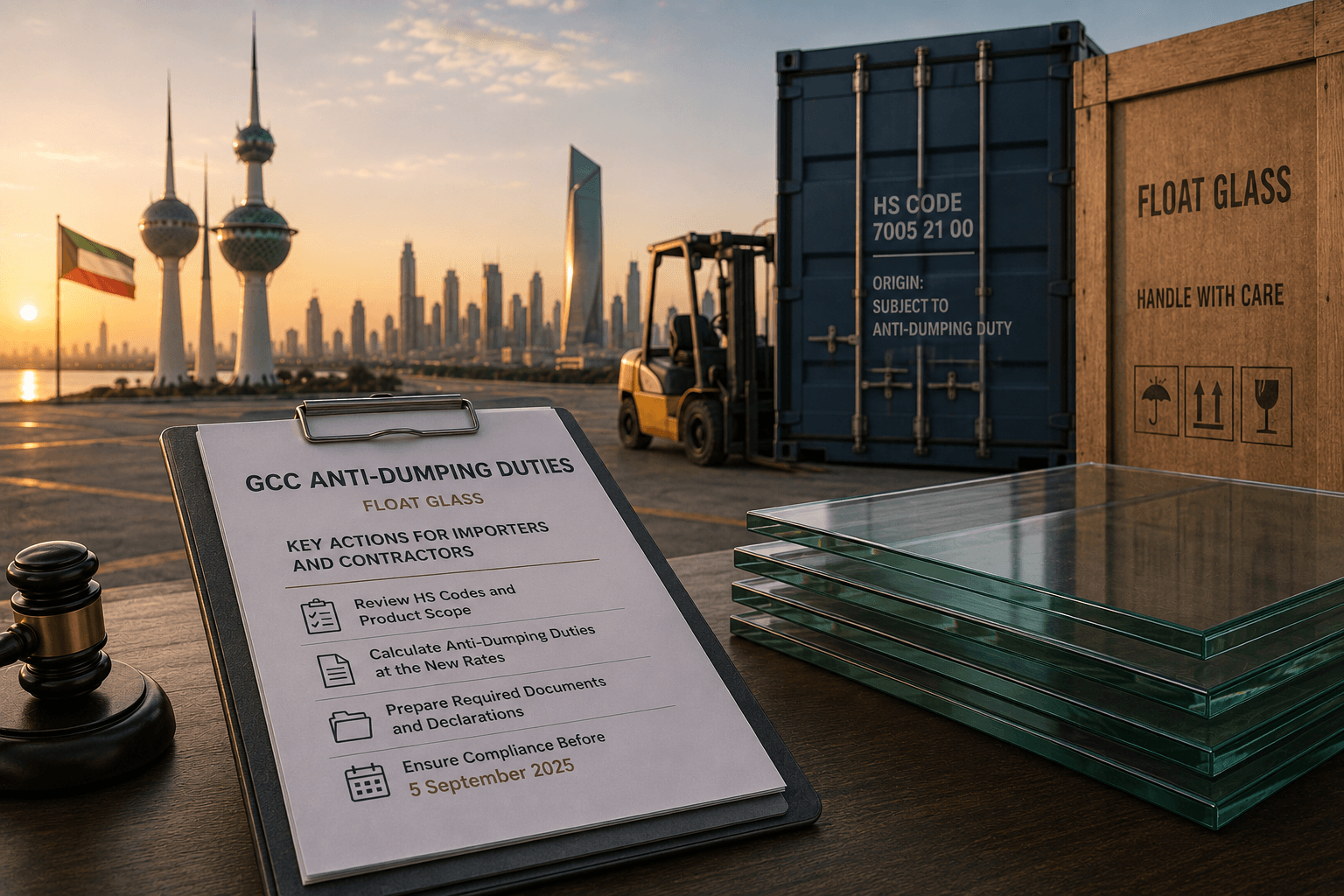
Kuwait Enforces GCC Anti-Dumping Duties on Float Glass: What Importers and Contractors Should Do Before 5 September
31-08-2026
Anti-Dumping DutiesGCC Trade RemediesCustoms ComplianceConstruction
On 30 August 2026 the General Administration of Customs published Customs Instructions No. 27 of 2026 in Kuwait Al-Youm Issue 1806, giving effect in Kuwait to a GCC-wide decision imposing definitive anti-dumping duties on float glass originating in or exported from China and Iran. The duties apply from 5 September 2026 and will remain in place for five years.
Why this matters: Float glass is the basic building glass used in windows, facades, mirrors and interior fit-out, and a large share of what the Kuwaiti market consumes comes from Chinese mills. From 5 September, most of those imports will carry an extra duty of between 6.7 and 14.4 per cent of the shipment's value, and Iranian glass will carry 56.3 per cent. That feeds directly into the cost of curtain walls, window packages and fit-out works, and into every contract that prices them.
What anti-dumping duties are
Dumping means selling an exported product below the price it fetches in its home market, in a way that injures the industry of the importing country. The GCC states investigate these cases jointly under the GCC Common Law on Anti-Dumping, Countervailing and Safeguard Measures, through a technical secretariat based in Riyadh. The float glass investigation opened in November 2024 following a complaint by GCC glass producers. It ended with a recommendation from the Permanent Committee for Combating Harmful Practices in International Trade to impose definitive duties, which the Industrial Cooperation Committee approved at its 55th meeting on 29 October 2025 and the Financial and Economic Cooperation Committee endorsed at its 125th meeting. Each member state's customs authority then collects the duties at its own border. Kuwait's instructions are that final step.
What the duties cover
The measures apply to unworked float glass and to glass ground or polished on one or both faces, in sheets, including glass with an absorbent or reflective layer, provided it is not otherwise worked. The relevant tariff items are 7005.10.00, 7005.21.00 and 7005.29.00 of the GCC unified customs tariff. Ultra-clear float glass is expressly excluded, which matters for specialised architectural and solar applications.
Who pays what
The duty is calculated as a percentage of the CIF value, meaning the value of the goods including cost, insurance and freight to the port. For Chinese producers, Yaohua (Qinhuangdao) Glass Co., Ltd pays 6.7 per cent. CNG (Weihai) Special Glass Co., Ltd pays 8.3 per cent, as do three cooperating producers that were not selected in the investigation sample: Zhangzhou Kibing Glass Co., Ltd, Langfang Jinbiao Glass Co., Ltd and Tengzhou Jinjing Glass Co., Ltd. Every other Chinese producer or exporter pays 14.4 per cent. All Iranian companies pay a single rate of 56.3 per cent. The duties are collected alongside, and treated in the same way as, ordinary customs duties.
Six practical steps before 5 September
First, map your exposure. Review purchase orders and shipments that will be cleared through customs on or after 5 September. The duty attaches at customs clearance, so goods already on the water can still be caught even if the purchase contract was signed months ago.
Second, identify the actual producer behind each shipment. The rate depends on the named company, and the difference between 6.7 and 14.4 per cent is real money on a large facade package. Supplier declarations, mill certificates and certificates of origin need to tie the goods clearly to the producer whose rate you are claiming.
Third, check classification and specifications. Confirm whether your product falls within the three tariff items, and gather the technical evidence if you intend to rely on the ultra-clear exclusion. Classification disputes at the border are far easier to avoid than to unwind.
Fourth, review live contracts. Contractors should check change-in-law and price-adjustment clauses in ongoing projects to see who bears the new duty, and new tenders should price it in from the start. Suppliers should review whether their standard terms allow the duty to be passed on.
Fifth, weigh alternative sourcing carefully. GCC-produced glass is not subject to the duties, and other origins are unaffected. What businesses must not do is route Chinese or Iranian glass through a third country to disguise its origin. That is circumvention, and it exposes the importer to back-duties and penalties.
Sixth, remember the duties are not necessarily permanent. The GCC framework allows interested parties to seek reviews in defined circumstances, and the duties expire after five years unless extended following a further review.
WEFAQ advises: importers, glazing and facade contractors and developers should audit their glass supply chains before 5 September and document producer identity and product specifications carefully. The difference between 6.7 per cent and 14.4 per cent, or between exclusion and 56.3 per cent, is a documentation question as much as a sourcing one.
• • •
Source: Customs Instructions No. 27 of 2026, General Administration of Customs; Kuwait Al-Youm Issue 1806, page 254, 30 August 2026.
This article is provided for general information only and does not constitute legal advice. For advice specific to your circumstances, please contact WEFAQ Law Firm.
Related articles


Kuwait Media Law 2026: What It Means for Influencers, Companies and Media Businesses
Learn more
UPDATE: What Kuwait's Amended Public Tenders Law Means for Contractors and Suppliers
Learn more
The Capital Markets Court Is Being Retired: What Decree-Law 91/2026 Means for Issuers, Brokers and Investors
Learn more
UPDATE: How Kuwait's Government Sukuk Programme Will Work
Learn more