

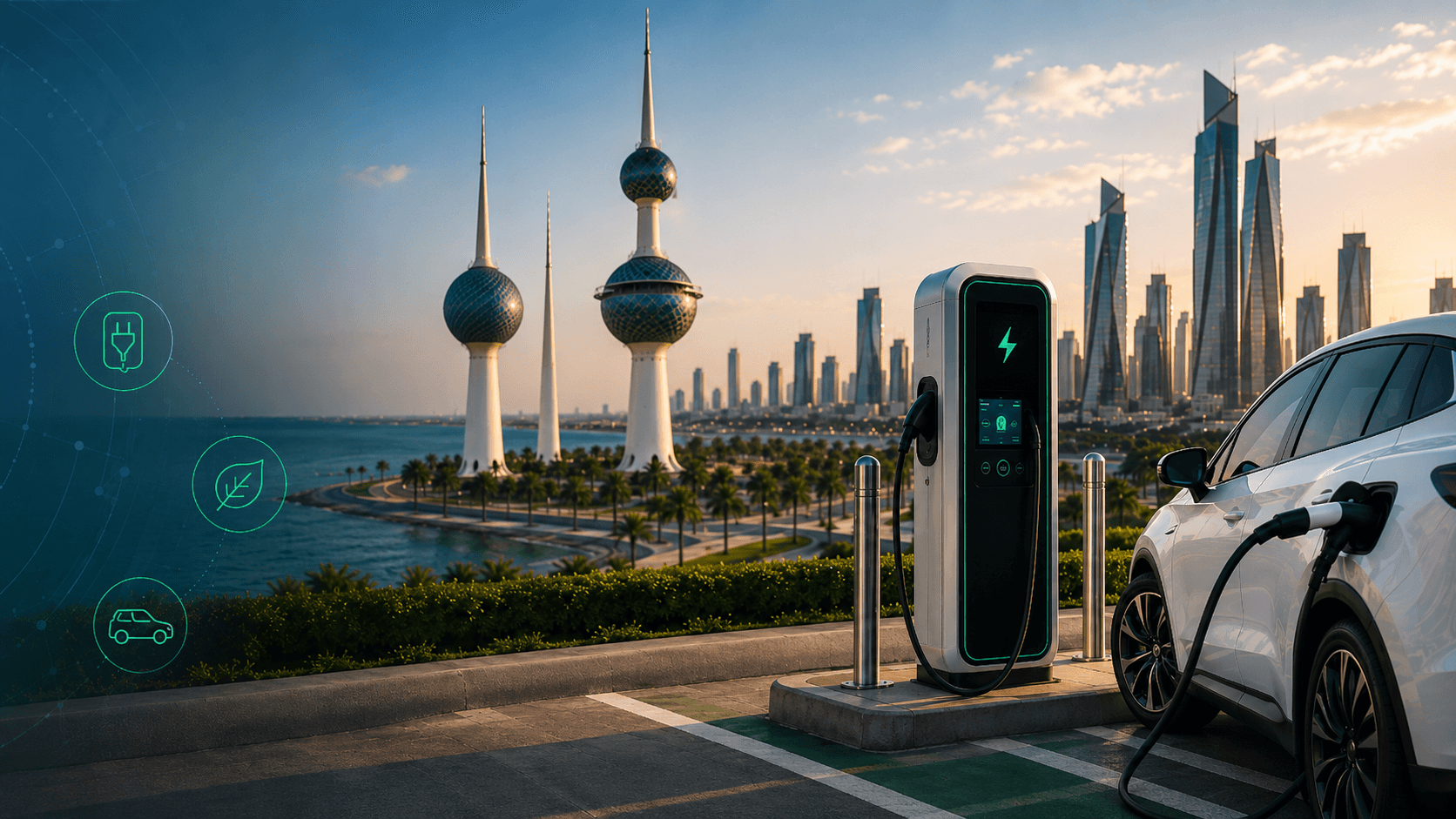
Kuwait's EV Charging Market Gets Its Licence: A Roadmap for Operators and Suppliers
24-08-2026
EV InfrastructureCommercial LicensingRenewable EnergyMarket Entry
On 17 August 2026 the Minister of Commerce and Industry signed Ministerial Decision No. 167 of 2026, published in Kuwait Al-Youm Issue 1805 on 23 August 2026. The decision creates two licensable commercial activities for electric vehicle charging: operating and managing charging stations (unified code 351006) and selling, installing and maintaining charging devices and equipment (code 331409).
Why this matters: until this decision, a company could import chargers, sell them, even build a station, but it could not point to a licence category that described the business. Operators squeezed the work under general electrical contracting or trading codes, which left room for doubt with banks, insurers, landlords and government counterparties. A named activity with a named supervising regulator removes that doubt. It is the same shift Kuwait made for artificial intelligence services earlier this month, now applied to the EV market.
What the decision does
The mechanics are simple. Kuwait keeps a unified guide of commercial activities, aligned with the classification used across the Gulf Cooperation Council states. Decision 167 adds two entries to that guide and rewords two others. The additions respond to a request from the Ministry of Electricity, Water and Renewable Energy in July 2026, supported by the Ministry of Interior in August. The rewordings come from the Directorate General of Civil Aviation: aircraft catering is renamed “ground services for preparing and supplying aircraft meals” (code 562120), with the Public Authority for Food and Nutrition added as a joint supervisor, and “aviation schools” become “aviation training centres” (code 854991).
Two activities, two supervision models
Station operation (code 351006) sits under electricity and energy supply activities and carries joint supervision: the Ministry of Electricity, Water and Renewable Energy on one side and the General Traffic Department at the Ministry of Interior, through its traffic engineering arm, on the other. In practice that means an operator will deal with the electricity ministry on grid connection and power supply, and with traffic engineering on site layout, access and parking. Anyone planning a network of stations should budget time for both approval tracks.
Equipment sale, installation and maintenance (code 331409) is the simpler licence. It covers importers, retailers, electrical contractors and after-sales service providers, and answers to the electricity ministry alone. Car dealers bundling a home charger with an EV sale, and contractors offering installation, are the natural holders of this code.
The technical rules were already there
Kuwait approved a technical regulation for EV chargers before it created the commercial licence. Those rules set specifications for alternating and direct current chargers, connectors and energy storage, and list where stations may be installed: petrol stations, highways and main roads, government sites and commercial buildings. Implementation runs in phases, with the current phase extending to 31 December 2030, and fuel stations have been directed to install fast chargers. Read the two instruments together: the technical regulation tells you how to build a compliant station, and Decision 167 tells you what licence you need to run one as a business.
Steps to take now
New entrants should add code 351006, code 331409 or both at incorporation, then sequence the sector approvals before committing to sites or signing supply contracts. Existing electrical contractors and dealers already selling chargers should regularise by adding code 331409 to their current licence. Fuel station operators subject to the fast-charger direction should confirm whether their existing licence covers operation of the chargers or whether code 351006 must be added. Landlords and mall owners hosting stations are not the operator, but they should paper the arrangement properly: lease or licence terms, electricity metering and cost recovery, and responsibility for the equipment. Foreign investors can combine the new activities with the direct investment route under Law No. 116 of 2013, which allows up to 100 percent foreign ownership where the project qualifies through the Kuwait Direct Investment Promotion Authority.
What remains open
The decision names the activity and its supervisors; it does not yet answer every operating question. The main open points are connection and metering rules for stations, how the resale of electricity to drivers will be priced, and how the traffic engineering approval will run in practice. Further codes may follow as the market develops, for example battery swapping or home charger installation as a separate craft licence.
WEFAQ advises businesses planning charging investments to secure the new activity codes early, sequence the electricity and traffic approvals before signing site commitments, and keep hosting and supply contracts aligned with the technical regulation.
• • •
Source: Ministerial Decision No. 167 of 2026 dated 17 August 2026, Kuwait Al-Youm Issue 1805, pages A5-A6, dated 23 August 2026.
This article is provided for general information only and does not constitute legal advice. For advice specific to your circumstances, please contact WEFAQ Law Firm.
Related articles


Kuwait Media Law 2026: What It Means for Influencers, Companies and Media Businesses
Learn more
UPDATE: What Kuwait's Amended Public Tenders Law Means for Contractors and Suppliers
Learn more
The Capital Markets Court Is Being Retired: What Decree-Law 91/2026 Means for Issuers, Brokers and Investors
Learn more
UPDATE: How Kuwait's Government Sukuk Programme Will Work
Learn more